
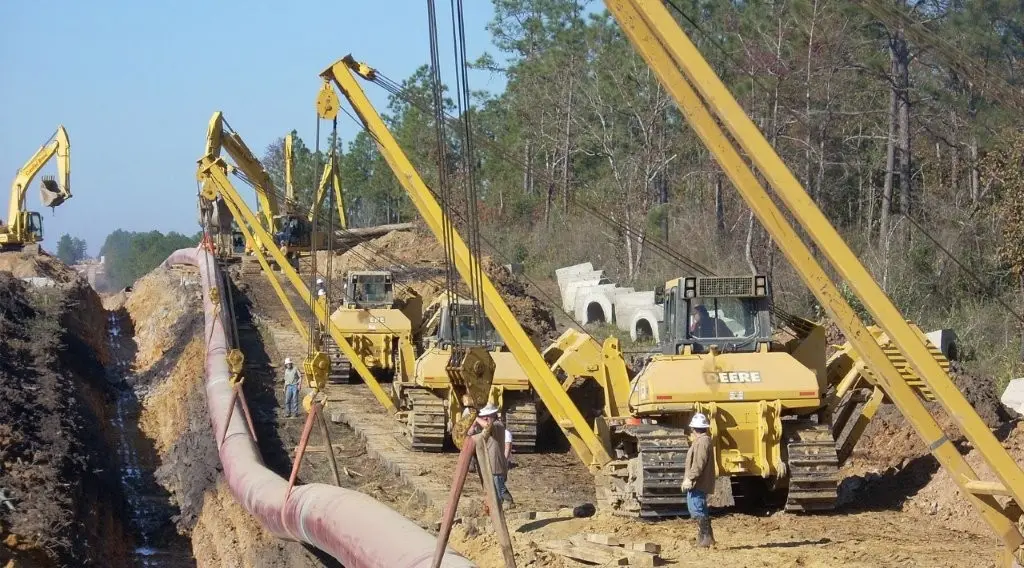
Pipeline Lowering: How the Process Works and Why Equipment Matters
Pipeline lowering is the operation of lifting the welded pipe string from the skids and placing it into the trench. It is the moment the entire spread has been building toward. Everything upstream of this operation, the ditching, the stringing, the welding, and the coating, all converges on the lowering-in crew and the sidebooms doing the work.
It is also the highest-stakes operation on the spread. More load, more machines working in coordination, and more things that can go wrong. Understanding how pipeline lowering works and how equipment selection affects the outcome matters to anyone managing or speccing a spread. The PHMSA overview of pipeline construction phases notes that lowering-in requires careful, uniform pipe placement to prevent overstressing and coating damage. That is the goal, and the equipment is what makes it achievable.
What Is Pipeline Lowering?
Pipeline lowering, also called ‘pipeline lowering-in’, is the coordinated operation of lifting a welded, coated pipe string off its temporary supports and placing it uniformly into the prepared trench. It follows the welding and coating operations and precedes backfill.
The pipe string at this stage is a continuous welded length, sometimes hundreds of feet and sometimes over a mile, that has been assembled along the edge of the trench and coated for corrosion protection. Lowering-in places this string into its permanent position.
The operation is not a single lift. It is a moving, coordinated sequence of multiple sidebooms working simultaneously along the string, each holding a section of pipe while the whole string descends uniformly into the trench.
The Sequence: What Happens During Lowering-In
Pipeline lowering follows a defined sequence. Understanding each step helps clarify why equipment matters at every stage.
Step 1: Pre-Lowering Preparation
Before any pipe leaves the skids, the trench bottom is inspected and prepared. Bedding material, such as screened fill, sand, or padding, is placed in rocky or abrasive sections to protect the pipe coating during lowering. The trench grade is checked for line and elevation. Equipment is positioned along the string, sidebooms are spaced, and belts or slings are rigged under the pipe at each lift point.
Lift point spacing is a calculated decision, not guesswork. The pipe must be supported at intervals that keep bending stress within allowable limits for that pipe’s diameter, wall thickness, and grade. Load monitoring systems on modern sidebooms help operators verify each machine is carrying its intended load before and during the lift.
Step 2: Picking Off the Skids
With sidebooms positioned and rigged, the lowering foreman signals the lift. All machines pick up simultaneously, raising the string just enough to clear the skids. This initial pick is a coordination challenge because machines at different positions along the string carry different loads depending on the string’s weight distribution and any grade changes in the terrain.
If one machine carries significantly more or less load than planned during the pick, it is corrected before the string travels any further. This is when crew communication and operator experience matter most.
Step 3: Moving to the Trench
With the string lifted clear of the skids, machines travel laterally toward the trench. In most cases, the string is already positioned above the trench and the sidebooms lower in place. Each machine coordinates boom travel to keep the string level and maintain planned load distribution as the pipe transitions from its supported position to the suspended one.
Step 4: Lowering Into the Trench
The controlled lowering begins. All machines lower simultaneously at a rate the foreman controls through signals or radio communication. The string descends uniformly, which is a critical requirement. Differential lowering between machines creates bending moments in the pipe that can exceed allowable limits and damage the pipe or its coating.
PHMSA requires that pipeline be lowered into the trench in a smooth and uniform manner specifically to prevent overstressing. This requirement reflects the pipe’s structural limits, not just procedural preference. Pipe protection products including skids, cradles, and padding materials protect the coating from damage as the pipe contacts the trench bottom.
Step 5: Releasing and Moving Up
Once the string rests on the trench bottom, operators confirm the pipe is properly bedded and seated. Belts and slings are released and retrieved. Machines move forward to the next section of string, and the sequence repeats.
The pace at which the lowering crew can advance is a direct function of the spread’s production rate. A well-organized lowering-in operation that keeps pace with the welding crew defines a productive spread.
Why Equipment Selection Determines Lowering-In Performance
Pipeline lowering is where equipment capability translates directly into field outcome. Here is where it matters most.
Rated Capacity at Working Radius
Each sideboom must carry its portion of the string’s weight at the actual working radius the trench width and pipe diameter require. A machine with a nameplate capacity that looks sufficient may have significantly less capacity at the working radius when the boom is extended over a wide trench. Understanding load charts, not just nameplate ratings, is essential before the lowering crew is assembled.
Precision Hydraulic Control
Uniform lowering requires each operator to control boom descent with precision. Hydraulic sideboom systems with fine control allow operators to match lowering rates precisely. The difference between a smooth, uniform descent and a jerky, uncoordinated one is often the hydraulic control quality of the machines in the crew.
Load Monitoring
Modern spreads increasingly run load monitoring and anti-two-block systems on lowering-in machines. These systems give operators real-time load readings, helping ensure no single machine is overloaded during the pick or the descent and providing a safety stop if the hoist approaches the two-block condition. On large-diameter, high-value pipe installations, load monitoring is rapidly becoming standard practice.
Recovery Capability
Something always eventually goes wrong on a long spread. A machine goes down during a lowering operation and the string is suspended while the crew works to recover. Having recovery winch capacity on the spread means the string can be safely supported while the machine is repaired or replaced. Operating a lowering-in crew without recovery capability on long strings is a risk most experienced project managers avoid.
The Fleet That Makes Pipeline Lowering Work
The sideboom is the centerpiece of the pipeline lowering operation but it does not work alone. The full lowering-in fleet typically includes multiple sidebooms matched to the pipe spec and lift point requirements, pipe protection products at the trench bottom in rocky or abrasive sections, load monitoring on key machines, recovery winch capacity on the spread, and a lowering foreman with the experience to coordinate the crew. Our post on how to plan a pipeline spread covers fleet sizing in detail, including how many sidebooms lowering-in operations typically require for different pipe diameters and project conditions.
Midwestern Equipment for Pipeline Lowering
Midwestern builds the equipment that pipeline lowering crews depend on. Our CAT and John Deere sideboom pipelayer attachments cover lifting classes from 10,000 lb to 220,000 lb, matched to the pipe spec your project requires. Load monitoring, recovery winches, pipe protection products, and pipeline supplies round out the equipment picture. With 70+ years of field experience, we understand what a lowering-in crew needs to run effectively.
If you are planning a project and want to discuss equipment configuration for your lowering-in operation, contact us.
Frequently Asked Questions
What is pipeline lowering?
Pipeline lowering, also called lowering-in, is the operation of lifting a welded, coated pipe string off its temporary skid supports and placing it uniformly into the prepared trench. It is performed by a coordinated team of sideboom pipelayers working simultaneously along the pipe string, controlling the descent so the pipe reaches the trench bottom smoothly and without overstressing the pipe or its coating.
How many sidebooms are needed for pipeline lowering?
The number of sidebooms depends on pipe diameter, weight per foot, required lift point spacing, and terrain. Small-diameter lines may need 2 to 4 machines. Large-diameter transmission pipeline lowering operations commonly run 6 to 12 or more sidebooms simultaneously. Our post on how to plan a pipeline spread covers fleet sizing in detail.
What determines lift point spacing during pipeline lowering?
Lift point spacing is determined by the pipe’s diameter, wall thickness, grade, and coating weight, along with the bending stress limits of the pipe specification. Enough lift points must be used so that bending stress in the suspended pipe between supports stays within allowable limits and each machine’s load stays within its rated capacity at the actual working radius.
What can go wrong during pipeline lowering-in?
The most common issues include uneven load distribution causing one machine to carry more than its rated capacity, differential lowering rates creating bending moments in the pipe, coating damage from contact with rocky trench walls or an unsupported trench bottom, and mechanical failure of a machine mid-operation. Load monitoring systems, proper lift point spacing, pre-lowering inspection, and recovery winch capacity on the spread all reduce these risks.
What regulations apply to pipeline lowering operations?
PHMSA’s pipeline construction guidelines require that pipeline be lowered into the trench in a smooth and uniform manner to prevent overstressing and coating damage. ASME B30.14 sideboom standards, incorporated into OSHA 29 CFR 1926.1440, govern sideboom equipment requirements and operator qualifications for the lowering-in crew.
Author: Joe B.
Comments are closed.