
Re-Railing Rail Cars: How Derailed Cars Are Lifted Back Onto the Track
A single derailed railcar can shut down an entire line. Getting that car, or dozens of them, safely back onto the track is the heart of derailment recovery, and it is a job that demands the right equipment, a careful process, and an experienced crew. Re-railing is not simply a matter of brute force. Done wrong, it causes further damage to the car, the track, and the crew’s safety margin, and it can turn a bad day into a far worse one. This guide explains how re-railing rail cars actually works, walks through the process step by step, covers the equipment that makes it possible, and explains why controlled lifting is everything.
What Does Re-Railing Mean?
Re-railing is the process of lifting a derailed railcar and repositioning it back onto the rails so it can be moved and the line reopened. Depending on the incident, a car may be sitting just off the rail, tipped onto its side, or tangled with other cars in a pile-up. Each situation calls for a different plan, and each requires equipment capable of lifting enormous weight with precision rather than force alone. A car that has left the rails is often in an awkward, unstable position, and the goal is always to return it to the track without causing additional harm.
The Re-Railing Process, Step by Step
While every derailment is different, the re-railing process generally follows a consistent sequence. The diagram below outlines the five core stages, each of which depends on careful judgment and controlled equipment handling.
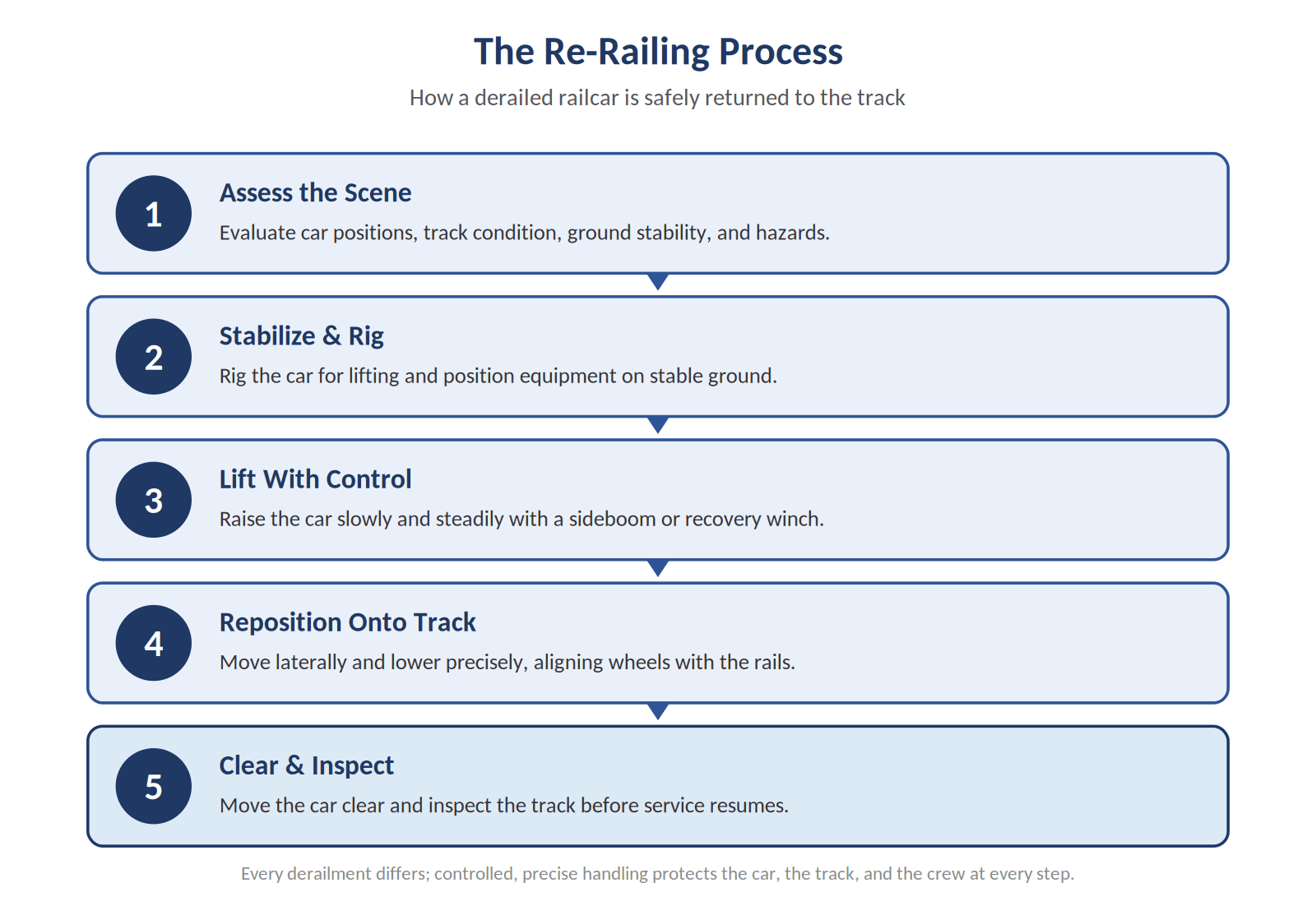
1. Assess the Scene
Before anything is lifted, crews evaluate the position of the cars, the condition of the track, the stability of the ground, and any hazards present, such as spilled cargo or damaged infrastructure. This assessment shapes the entire recovery plan. Rushing it is how mistakes happen.
2. Stabilize and Rig
The car is rigged for lifting, and the recovery equipment is positioned on stable ground with a clear, planned lift path. Proper rigging is critical: it determines how the load will behave when it leaves the ground. Equipment placement matters just as much, since a machine on unstable footing is a hazard to everyone on site.
3. Lift With Control
Using a sideboom or recovery winch, crews lift the car in a slow, controlled motion, keeping it steady to avoid shifting loads or secondary damage. This is where equipment quality shows. Smooth hydraulics and precise controls let the operator manage the load rather than fight it.
4. Reposition Onto the Track
The car is moved laterally and lowered precisely back onto the rails, aligning its wheels with the track. This step demands fine control, since the car must be set down accurately, not just approximately. A sideboom’s side-lifting geometry is especially well suited to this lateral repositioning.
5. Clear and Inspect
Once re-railed, the car is moved clear and the track is inspected before service resumes. The track may have been damaged in the derailment, and it must be confirmed before it resumes carrying traffic.
The common thread across all five steps is control. A loaded railcar carries tremendous momentum even when moving slowly, so smooth, predictable equipment handling is what keeps the operation safe and prevents making a bad situation worse.
The Equipment That Re-Rails Cars
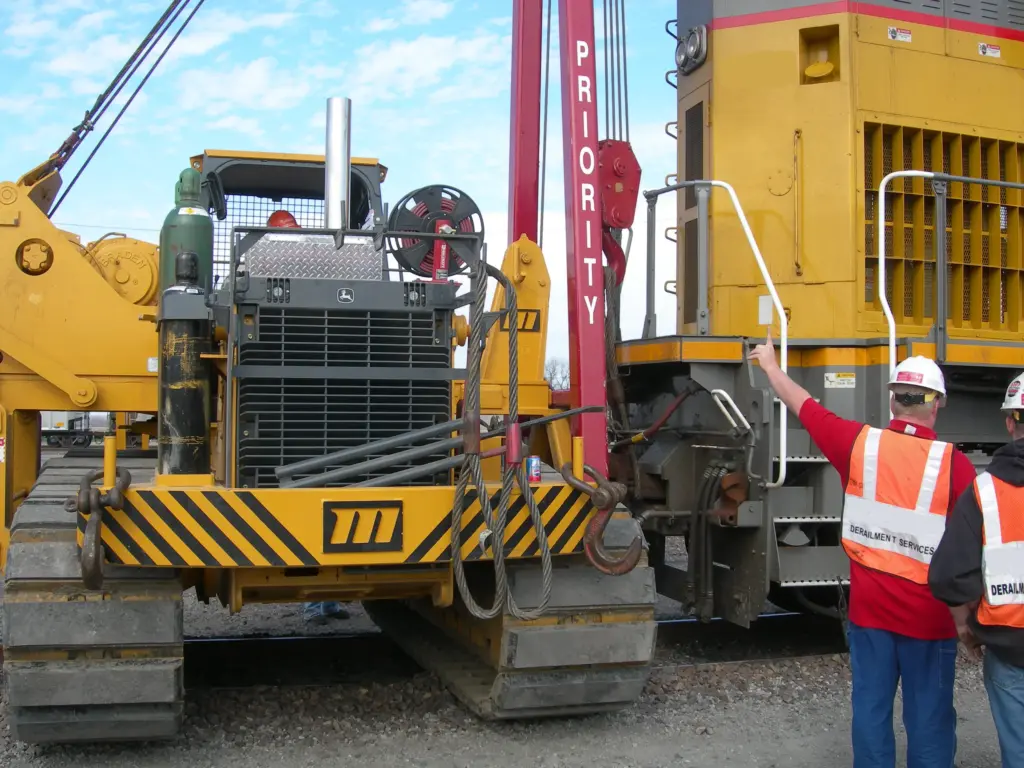
Two machines do most of the re-railing work, and often they work together. The recovery sideboom provides the controlled lifting, and the recovery winch provides the pulling power. Midwestern’s railroad recovery sidebooms, the M572C-RR and M583C-RR, are engineered specifically to lift, hold, and position railcars with the stability re-railing demands, offering lifting capacities up to 200,000 pounds with a hydraulic design built around safety. Their offset boom geometry is ideal for the lateral lifting and placing that re-railing requires.
For the pulling side of the job, the M100W recovery winch mounts on an excavator and delivers up to 100,000 pounds of line pull. When a car needs to be dragged into alignment before a lift, or a heavy component repositioned, that pulling power is what gets it done. Because it uses an excavator many crews already operate, it adds serious capability without a dedicated single-purpose machine. Together, the sideboom and winch give a recovery crew both the lift and the pull a re-railing job requires.
Both of these machines are covered in our overview of railroad recovery equipment, which looks at the full range of recovery machinery and how the pieces work together.
Why Controlled Lifting Prevents Further Damage
The difference between a clean re-railing and a costly one comes down to control. A car lifted too fast or held unsteadily can swing, shift its load, or slip, damaging the car, the track, or nearby equipment, and endangering the crew. The forces involved are enormous, and they are unforgiving of mistakes. Equipment engineered for smooth, precise movement, with simplified controls that reduce operator error, is what allows crews to lift heavy cars confidently and set them down exactly where they need to go. In re-railing, precision is not a luxury. It is what protects both the schedule and the people on site.
Speed and Safety Go Together
There is constant pressure to reopen a line quickly, but speed can never come at the expense of safety. Reportable derailments are investigated under federal oversight, and the Federal Railroad Administration tracks rail accidents closely. The fastest safe recovery comes from having reliable, purpose-built equipment and using it with a disciplined process, not from rushing or cutting corners. Good equipment makes speed and safety allies rather than trade-offs, letting a crew move quickly precisely because they are in full control of the load.
Frequently Asked Questions
What does re-railing a train car mean?
Re-railing is the process of lifting a derailed railcar and repositioning it back onto the rails so it can be moved and the line reopened. It requires equipment capable of lifting very heavy cars with precision and control.
What equipment is used to re-rail rail cars?
Recovery sidebooms and excavator-mounted recovery winches are the main equipment used. Sidebooms provide controlled lifting and positioning, while recovery winches provide the pulling power to drag and align heavy cars and components.
How are derailed cars lifted back onto track?
Crews assess the scene, rig the car, and use a sideboom or winch to lift it in a slow, controlled motion. The car is then repositioned laterally and lowered onto the rails, after which the tracks are then inspected before service resumes.
Why is controlled lifting important in re-railing?
A loaded railcar is extremely heavy and carries momentum even at low speed. Controlled, precise lifting prevents the car from swinging, shifting, or slipping, which protects the car, the track, the equipment, and the crew from further damage or injury.
How long does it take to re-rail a derailed car?
It varies widely with the severity of the derailment, the number of cars, the terrain, and conditions. Reliable, purpose-built equipment and an experienced crew following a disciplined process are what keep re-railing as fast and safe as possible.
The Right Equipment for Re-Railing
Re-railing derailed cars safely takes equipment built for controlled, heavy lifting under pressure. Midwestern’s railroad recovery sidebooms and excavator winches are engineered for exactly that. To find the right machine for your recovery operation, contact Midwestern Manufacturing or explore our railroad recovery equipment.
Author: Joe B.
Comments are closed.