
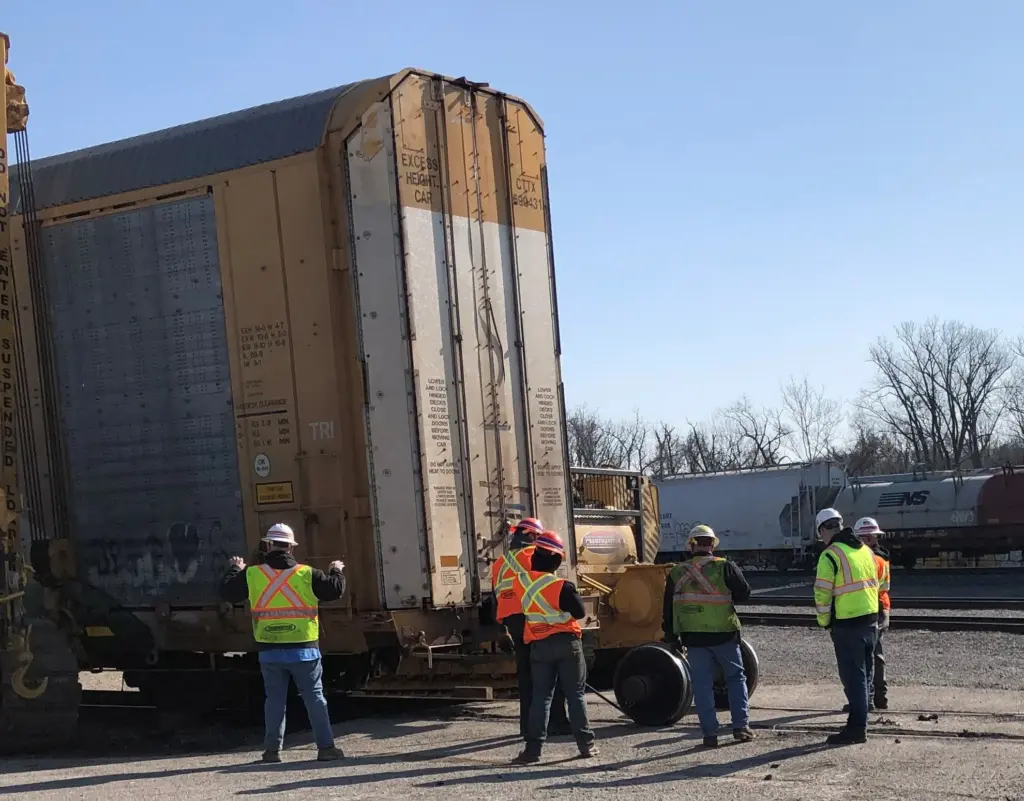
Railcar Maintenance: Lifting Equipment for Drive and Axle Work
Not all railcar lifting happens in an emergency. A large share of the work that keeps rail fleets running is planned maintenance, and much of it requires lifting or jacking heavy railcars to reach the components underneath. Replacing drives, servicing axles, and swapping out running gear all depend on being able to raise a railcar safely and hold it steady while crews work. This guide looks at railcar maintenance work, the lifting challenges it presents, the equipment that makes controlled work possible, and why stability matters just as much in a maintenance yard as it does at a derailment site.
Service Work Is Different From Recovery
Derailment recovery is fast, unpredictable, and driven by urgency. Railcar service and maintenance is the opposite: planned, controlled, and repeatable. A crew servicing a railcar has time to set up properly, a known task in front of them, and a stable work environment. But despite those differences, the two kinds of work share a fundamental requirement, which is the ability to lift and hold enormous weight safely.
Whether a car is being re-railed after an incident or raised in a yard for an axle replacement, the equipment has to manage the load with precision and stability. That shared capability is exactly why the same core recovery machines are so valuable for maintenance work. A contractor who owns capable lifting equipment for derailment response already has what they need for planned service, and vice versa.
Common Railcar Maintenance That Requires Lifting
Several routine service tasks depend on raising a railcar or its components. The table below maps common maintenance work to the lifting it requires and the equipment suited to it.
| Maintenance Task | What It Involves | Equipment Used |
|---|---|---|
| Drive replacement | Lifting the car to access and replace drive components | Recovery sideboom for controlled lift |
| Axle and wheelset service | Raising the car to inspect or replace heavy axles and wheelsets | Sideboom lift; winch for component handling |
| Running gear and truck work | Lifting to maintain the trucks and running gear the car rides on | Recovery sideboom for stable lifting |
| Component repositioning | Moving and placing heavy replacement parts | Excavator recovery winch for pulling and placing |
In each case, the constant is weight. Railcar components are heavy and awkward, and getting them safely up, held, and back into place is the core challenge that lifting equipment solves.
The Equipment Behind Planned Railcar Work
The sideboom and recovery winch that excel at derailment response are equally at home in planned service work. For lifting a railcar or major component, Midwestern’s railroad recovery sidebooms, the M572C-RR and M583C-RR, provide up to 200,000 pounds of lifting capacity with simplified controls and a hydraulic design that keeps the load steady and the operation safe. The controlled, precise movement that matters so much in recovery is just as valuable when a crew is positioning a car for axle work and needs it to stay exactly where it is placed.
For pulling, positioning, and handling heavy replacement components, the M100W recovery winch mounts on an excavator and delivers up to 100,000 pounds of line pull. Because it uses a machine many operations already have on hand, it adds heavy pulling capability to a service yard or maintenance site without a dedicated single-purpose machine. Both of these are part of the broader railroad recovery equipment lineup built for railroad work.
Why Controlled, Stable Lifting Matters in Service Work
In planned maintenance, there is no excuse for a rushed or unstable lift. A railcar raised for service must be held securely and predictably while crews work beneath and around it, often in close physical contact with the load. Equipment engineered for smooth, controlled lifting protects the workers, the car, and the components being serviced. Simplified controls reduce the chance of operator error, and a stable hydraulic design keeps the load exactly where it needs to be. Safe work practices around railroad equipment are emphasized by the Federal Railroad Administration, and for service work, where people are in close contact with a suspended load, that reliability is everything.
One Set of Equipment, Many Railroad Jobs
The strength of purpose-built railroad recovery equipment is its versatility. The same sideboom and winch that respond to a derailment, restore storm-damaged track, and re-rail cars also support the planned maintenance that keeps a fleet healthy. For a contractor or operation, that means a single, capable set of equipment covers a wide range of railroad work, from emergency response to routine service. It is an efficient, dependable foundation for anyone working on or around rail, and it means the investment in quality equipment pays off across every kind of job, not just the dramatic ones.
Frequently Asked Questions
What equipment is used for railcar maintenance and service?
Recovery sidebooms and excavator-mounted recovery winches are widely used for railcar maintenance work. Sidebooms provide controlled lifting to raise cars and components for drive and axle work, while recovery winches handle pulling and positioning of heavy parts.
How are railcars lifted for axle and drive replacement?
Railcars are raised using heavy-capacity lifting equipment such as sidebooms, which hold the car steady and secure while crews access and service the axles, drives, and running gear underneath. Controlled, stable lifting is essential for safety.
Can recovery equipment be used for planned maintenance, not just derailments?
Yes. The same sidebooms and recovery winches used in derailment response are well suited to planned railcar maintenance. Their heavy lifting capacity, controlled movement, and stability make them valuable for both emergency recovery and routine service.
Why is controlled lifting important in railcar service work?
During service work, crews often work in close contact with a raised railcar. Controlled, stable lifting keeps the load secure and predictable, protecting workers, the car, and the components being serviced from accidents or damage.
What is the advantage of an excavator-mounted recovery winch for service work?
An excavator-mounted recovery winch adds heavy pulling power using a machine many operations already have on hand. Midwestern’s M100W delivers up to 100,000 pounds of line pull, making it a versatile tool for handling and positioning heavy components in a service setting.
Equipment for Every Stage of Railcar Work
From emergency recovery to planned drive and axle service, Midwestern’s railroad recovery sidebooms and excavator winches give crews the lifting and pulling power the work demands, safely and reliably. To find the right equipment for your operation, contact Midwestern Manufacturing or explore our railroad recovery equipment.
Author: Joe B.
Comments are closed.