
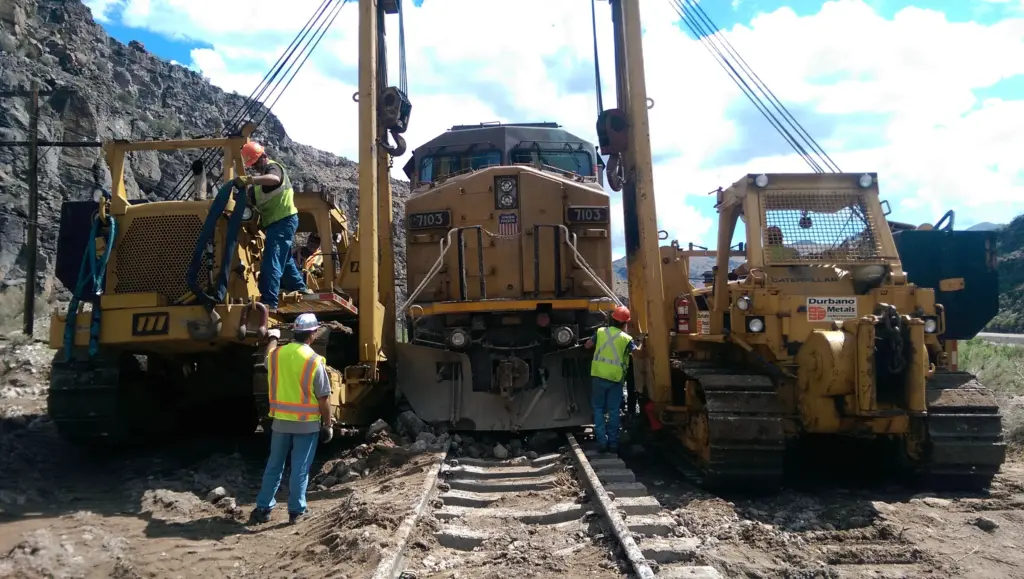
Railroad Track Repair After Storms and Flooding: Restoring the Line
Not every rail emergency starts with a derailment. Severe weather is one of the most persistent threats to rail infrastructure, and when a flood washes out a roadbed or a storm scatters debris and undermines track, the line is just as impassable as if a train had left the rails. Restoring storm and flood-damaged track is a specialized recovery job with its own distinct challenges, and it calls for equipment tough enough to work in the mud, water, and instability that severe weather leaves behind. This guide covers how severe weather damages tracks, the challenges of storm-driven railroad track repair, and the equipment that gets a line back in service.
How Severe Weather Damages Rail Tracks
Water is the great enemy of a stable roadbed. A rail line depends on a carefully built structure of compacted subgrade, ballast, ties, and rail, and flooding attacks every layer of it. The diagram below shows the four main ways storms and flooding compromise a rail line.
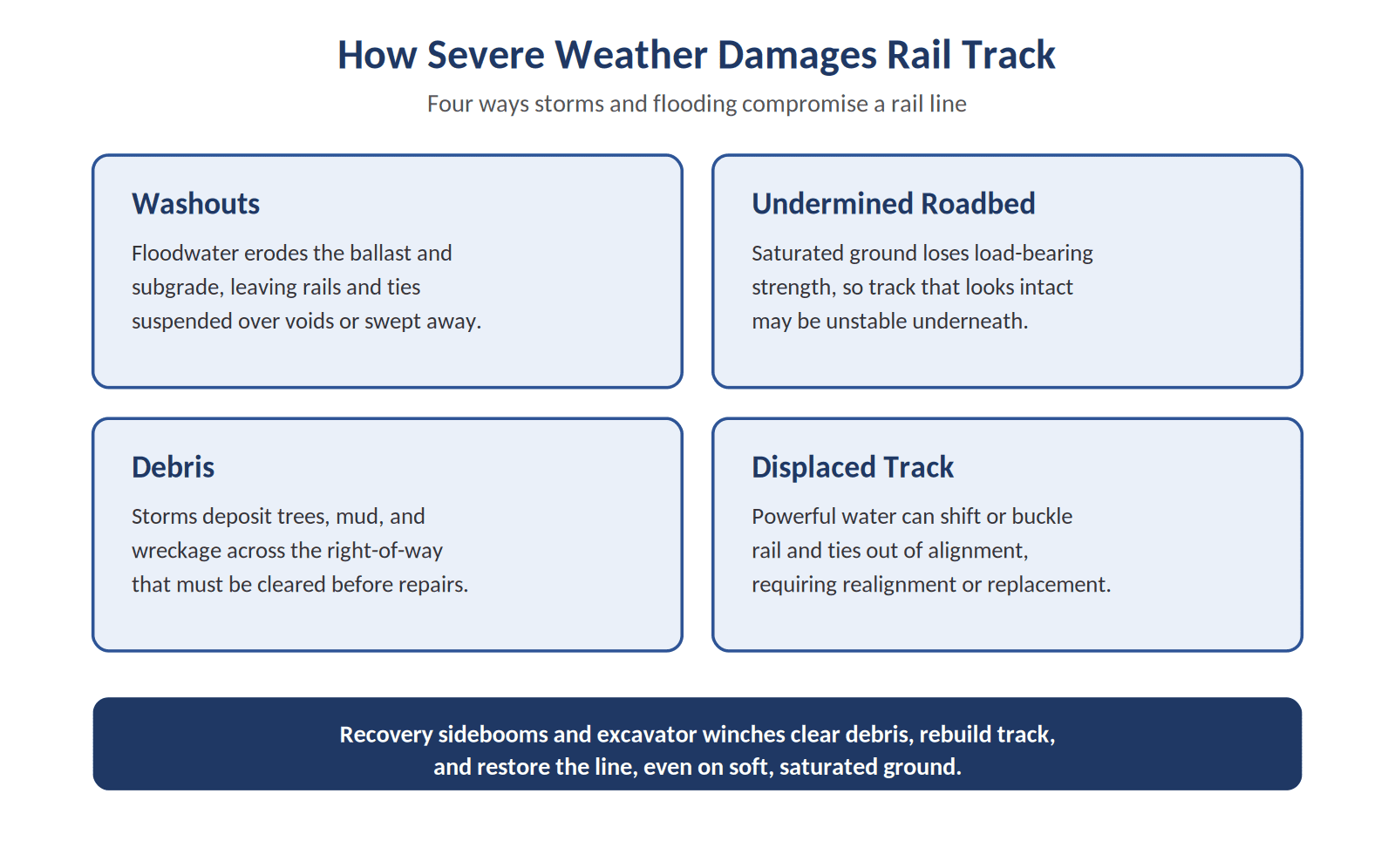
Each of these forms of damage requires a different response, and often a single storm produces all four at once:
- Washouts. Floodwater erodes the ballast and subgrade beneath the tracks, leaving rails and ties suspended over voids or swept away entirely. This is among the most serious and common forms of flood damage.
- Undermined roadbed. Saturated ground loses its load-bearing strength, so a track that looks perfectly intact may be dangerously unstable underneath. This hidden damage is especially hazardous because it is not always visible.
- Debris. Storms deposit trees, mud, and wreckage across the right-of-way that must be cleared before any repair work can begin.
- Displaced track. Powerful moving water can shift or buckle rail and ties out of alignment, requiring realignment or full replacement.
The Federal Railroad Administration oversees track safety standards, and damaged tracks cannot carry traffic until it is restored to a safe condition. That makes fast, thorough repair essential to getting a line back in service and keeping it safe once it reopens.
The Challenges of Working After a Storm
Storm and flood repair is demanding in ways that routine track work is not. Crews frequently work on soft, saturated ground where heavy equipment can bog down or lose stability, turning the recovery itself into a hazard. Access is often limited, with the roads and approaches to the site themselves damaged by the same weather. And the work is frequently urgent, carried out while more weather may still be moving through the area.
All of this means equipment used in storm recovery has to do more than lift and pull. It has to do so reliably on terrain that actively works against it. A machine that performs beautifully on firm ground but bogs down in mud is little use when the entire job site is saturated. This is why equipment selection is so critical to storm and flood work.
Equipment for Railroad Track Repairs After Storms
Restoring weather-damaged track draws on the same rugged recovery equipment used in derailment response, applied to a different problem. Recovery sidebooms handle the heavy lifting of rail, ties, and materials needed to rebuild a damaged section. Midwestern’s railroad recovery sidebooms, the M572C-RR and M583C-RR, bring lifting capacities up to 200,000 pounds with the stability and control this uncertain footing demands.
Excavator-mounted recovery winches earn their keep in storm work too. The M100W recovery winch, with up to 100,000 pounds of line pull, can drag debris clear, pull displaced track components back toward alignment, and reposition heavy material, all from an excavator that can maneuver on a compromised right-of-way. For the full picture of the machinery involved, see our overview of railroad recovery equipment.
Why Stability Matters on Saturated Ground
The defining challenge of flood repair is working on ground that will not hold. Soft, waterlogged soil can shift under a machine, turning a routine lift into a serious hazard. This is where equipment engineered for stability and low, controlled ground pressure proves its value. A machine that stays planted and predictable on soft terrain lets crews work safely and keeps the repair moving, while a machine prone to bogging down or tipping becomes a liability that slows everything down. Matching equipment to the terrain is one of the most important decisions in storm recovery work, and it is often the difference between a smooth repair and a stalled one.
Frequently Asked Questions
How are flood-damaged railroad tracks repaired?
Railroad track repair after flooding begins with clearing debris and assessing the damage, then rebuilding the ballast and subgrade, replacing or realigning rail and ties, and restoring the track to a safe condition before service resumes. The work relies on heavy lifting and pulling equipment able to operate on unstable, saturated ground.
What equipment is used for railroad track repair after a storm?
Recovery sidebooms and excavator-mounted recovery winches are central to storm and flood repair. Sidebooms lift rail, ties, and materials, while recovery winches clear debris and reposition heavy components, both operating on the difficult terrain that severe weather creates.
Why is flooding dangerous to railroad tracks even after the water recedes?
Floodwater erodes the ballast and subgrade beneath the track and saturates the surrounding ground. Track that looks intact may be suspended over voids or resting on unstable soil, so it must be inspected and restored before it can safely carry traffic.
Can recovery equipment work on soft, muddy ground?
Yes, when it is engineered for it. Equipment built for stability and controlled ground pressure can operate on the soft, saturated terrain left by flooding, which is essential for safe, effective storm and flood track repair.
Who repairs storm-damaged railroad tracks?
Specialized railroad recovery and maintenance contractors handle storm and flood repair, using fleets of sidebooms, excavators, and support equipment to clear debris, rebuild track, and restore service after severe weather.
Equipment Ready for the Worst Conditions
Storm and flood recovery tests equipment in the hardest conditions the field can offer. Midwestern’s railroad recovery sidebooms and excavator winches are built for that kind of work, combining heavy capacity with the stability difficult terrain demands. To match a machine to your recovery needs, contact Midwestern Manufacturing or explore our railroad recovery equipment.
Author: Doug G.
Comments are closed.