
Hydrostatic Testing of Pipelines: Process, Standards, and Safety
Before a new pipeline carries a drop of product, it has to prove it can hold pressure without leaking or failing. A hydrostatic test is how that gets done. Crews fill the line with water, pressurize it well above its operating pressure, and hold it there long enough to confirm the pipe, welds, and fittings are sound. It is one of the oldest and most trusted checks in pipeline construction, and it is required by federal regulation on most lines. This guide walks through what a hydrostatic test is, how the process runs step by step, the standards that govern it, and the safety practices that keep the crew protected.
What Is a Hydrostatic Test?
A hydrostatic test is a pressure test that uses water to verify the strength and integrity of a pipeline or pressure vessel. The line is filled with water, air is purged out, and the pressure is raised to a set multiple of the pipe’s maximum operating pressure. It is then held at that level for a defined period while crews watch for pressure loss that would signal a leak or a weakness in the pipe.
Water is the test medium of choice for a reason. It is nearly incompressible, so if a line does fail during the test, it releases its energy far less violently than a compressed gas would. That single property is why hydrostatic testing is considered the safest way to prove a pipeline, and why regulators generally require it over pneumatic methods. For a closer look at how water testing compares to air, see our breakdown of hydrostatic versus pneumatic testing.
How the Hydrostatic Testing Process Works
A hydrostatic test follows a repeatable sequence. The exact pressures and hold times depend on the line and the governing code, but the process generally runs like this:
- Preparation and isolation. The test section is isolated, cleaned, and gauged. Test heads, fittings, and instrumentation are installed, and the crew confirms the section can be safely filled and pressurized.
- Filling. Water is pumped into the line, displacing air as it goes. A high-flow fill pump moves large volumes of water efficiently, and air is vented so trapped gas does not compromise the test.
- Pressurization. Once filled, a high-pressure pump raises the line to the required test pressure, typically a set percentage above the maximum operating pressure.
- Hold and monitor. The line is held at test pressure for the required duration while crews record pressure and temperature. A stable reading confirms integrity; a drop points to a leak that must be found and repaired.
- Depressurization and dewatering. After a successful hold, the line is carefully depressurized, drained, and dried in preparation for service.
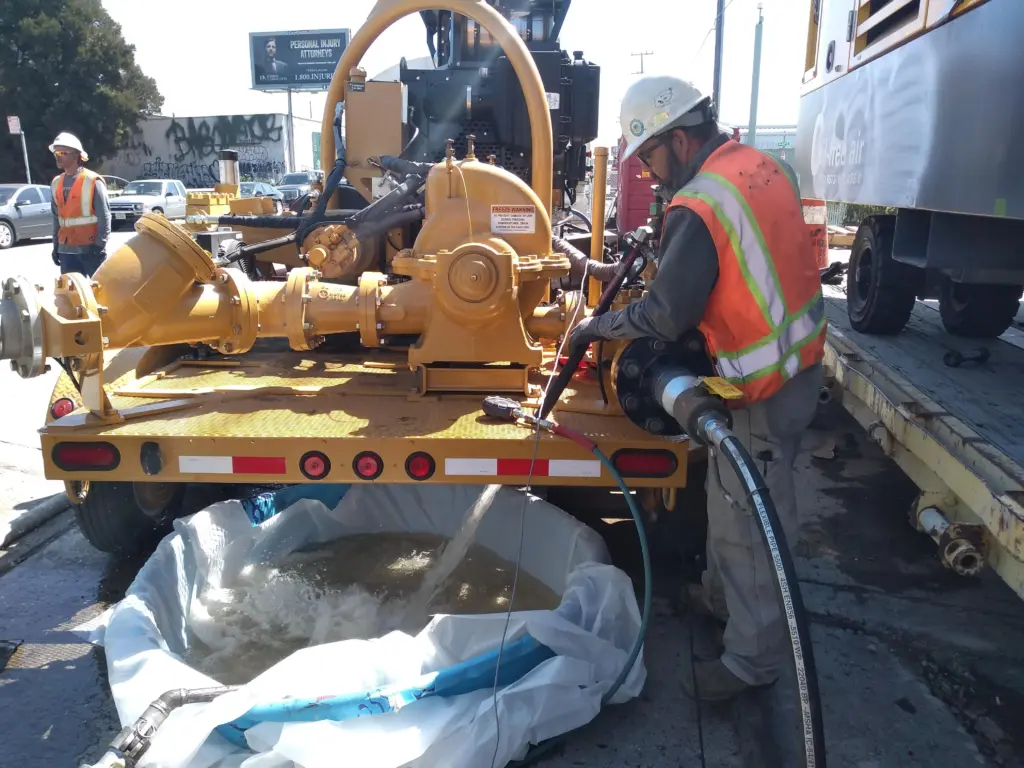
Modern equipment can handle filling and testing in a single setup. Midwestern Manufacturing’s Hydrostatic Fill & Test Units combine a high-flow centrifugal fill pump and a high-pressure triplex plunger pump with automatic switchover, so the same unit fills the line and then brings it up to test pressure without a separate changeover. Hydrostatic testing is one stage in a larger construction sequence, and the equipment that moves pipe into the trench beforehand matters just as much — our look at sideboom vs. crane vs. excavator covers how crews handle that stage.
Hydrostatic Testing Standards and Requirements
Hydrostatic testing of regulated pipelines is not optional, and the parameters are set by federal code, not by preference. In the United States, the Pipeline and Hazardous Materials Safety Administration (PHMSA) enforces these requirements under Title 49 of the Code of Federal Regulations, drawing on the ASME B31.4 code for liquid pipelines and ASME B31.8 for gas pipelines.
A few core requirements shape almost every test:
- Test pressure. For a steel pipeline operating at 30 percent or more of specified minimum yield strength, the test pressure must substantiate the maximum allowable operating pressure. In Class 1 and Class 2 locations near occupied buildings, the line must be tested to at least 125 percent of maximum operating pressure.
- Hold time. PHMSA guidance calls for testing to at least 125 percent of the maximum operating pressure for at least four continuous hours, plus an additional four hours at no less than 110 percent when the piping is not visible for inspection.
- Test medium. For hazardous liquid pipelines, water is generally required as the test medium, with narrow exceptions defined in the regulations.
The authoritative sources are worth bookmarking: PHMSA’s hydrostatic testing fact sheet, the strength-test rule at 49 CFR 192.505 for gas lines, and the Part 195 pressure-testing requirements for hazardous liquid lines. Always confirm the specific class location, code, and pressures that apply to your project before testing.
Safety During a Hydrostatic Test
A pipeline under test holds an enormous amount of stored energy, and the crew’s job is to manage it carefully. Water’s incompressibility makes hydrostatic testing far safer than pneumatic testing, but the pressures involved still demand discipline:
- Purge air completely. Trapped air introduces compressibility into an otherwise water-solid line, raising both the risk and the consequences of a failure. Thorough venting during fill is essential.
- Establish exclusion zones. Test heads and end caps are the highest-energy points on the line. Non-essential personnel stay clear while the line is pressurized.
- Monitor continuously. Pressure and temperature are logged throughout the hold. Temperature swings alone can move the gauge, so readings are interpreted against ambient conditions, not in isolation.
- Depressurize in a controlled way. Bleeding pressure down slowly and deliberately protects both the crew and the equipment at the end of the test.
Midwestern Manufacturing Hydrostatic Fill & Test Units
Midwestern Manufacturing has built pipeline equipment for more than 70 years, and its Hydrostatic Fill & Test Units are engineered to handle both stages of the test in one package. Each unit pairs a high-flow centrifugal fill pump with a high-pressure triplex plunger pump and automatic switchover capability, so a crew can fill a line and then pressurize it without swapping equipment. The units run off a hydraulic or manual clutch-engagement PTO and come mounted on a fully equipped tandem axle trailer for the field.
The line is offered in three sizes to match project scale:
- HTU-350, HTU-500, and HTU-850 — two-in-one fill-and-test units sized for different flow and pressure demands, all built to fill and test pipelines in a single, efficient setup.
To match a unit to your project, contact the Midwestern team.
Frequently Asked Questions
What is a hydrostatic test?
A hydrostatic test is a pressure test that uses water to verify the strength and integrity of a pipeline. The line is filled with water, pressurized above its maximum operating pressure, and held at that level while crews monitor for pressure loss that would indicate a leak or weakness.
What pressure is a pipeline hydrostatic test conducted at?
Under U.S. regulations, a steel pipeline in a Class 1 or Class 2 location near an occupied building must be tested to at least 125 percent of its maximum operating pressure. The exact test pressure depends on the pipe’s class location, operating pressure, and the applicable code.
How long does a hydrostatic test last?
PHMSA guidance calls for holding at least 125 percent of maximum operating pressure for a minimum of four continuous hours, with an additional four hours at no less than 110 percent when the piping is not visible for inspection. Actual hold times vary with the project and governing code.
Why is water used instead of air for pipeline testing?
Water is nearly incompressible, so it stores far less energy than compressed air at the same pressure. If a line fails during the test, a water-filled line releases that energy much less violently, which makes hydrostatic testing the safer and generally required method for most pipelines.
What standards govern pipeline hydrostatic testing?
In the United States, PHMSA enforces hydrostatic testing under 49 CFR Parts 192 (gas) and 195 (hazardous liquid), drawing on the ASME B31.8 and B31.4 codes. These set the required test pressures, hold times, and test medium for regulated pipelines.
Test With Confidence
A hydrostatic test is the proof that a pipeline is ready for service, and doing it right depends on both sound procedure and reliable equipment. Midwestern Manufacturing’s fill and test units are built to run the job efficiently and safely in the field. Explore our Hydrostatic Fill & Test Units or get in touch with our team to find the right fit for your project.
Author: Doug G.
Comments are closed.