
Ground Pressure and Terrain Stability: What Every Pipeline Crew Should Know
Pipeline routes rarely follow easy country. A single spread can cross firm farmland in the morning and soft, saturated ground by afternoon, then climb a side slope before the day is out. How a machine handles that variety comes down to two closely related ideas: ground pressure and stability. Get them right and the crew keeps moving safely. Get them wrong and you risk a bogged machine, a damaged right-of-way, or a lift that goes unstable on a slope. This guide explains what ground pressure is, how terrain and slope affect a machine’s stability, and what to look for in equipment built to work where the ground is anything but ideal.
What Is Ground Pressure?
Ground pressure is the downward force a machine exerts on the surface beneath it, spread across the area of its tracks or tires. It is usually expressed in pounds per square inch (psi). The math is simple in concept: take the weight of the machine and divide it by the total contact area touching the ground. A heavy machine on narrow tracks concentrates its weight into a small footprint and sinks; the same weight spread across wide tracks presses more gently and stays on top.
That is why two machines of similar weight can perform completely differently on soft ground. The one with a larger contact area, whether from wider track shoes, a longer track on the ground, or a wider gauge, distributes its weight over more square inches and exerts lower ground pressure. On a pipeline spread, low ground pressure is what lets a machine work across wet or unstable terrain without bogging down or tearing up the surface.
Why Ground Pressure Matters on a Pipeline Spread
Ground pressure is not an abstract spec. It shows up directly in how a job runs:
- Mobility on soft ground. Lower ground pressure keeps machines moving across wetlands, saturated soil, and soft river-crossing approaches that would strand a higher-pressure machine.
- Right-of-way protection. A machine that spreads its weight does less damage to topsoil and surface structure, which reduces the restoration work owed on the temporary easement after construction.
- Coating and pipe protection. Stable, controlled machine movement means smoother pipe handling and less risk of damaging protective coatings during placement.
- Safety. A machine that stays level and predictable on soft or uneven ground is a safer machine to run a load with.
How Terrain and Slope Affect Stability
Ground pressure governs whether a machine stays on top of soft ground. Stability governs whether it stays upright and keeps its rated lifting capacity while doing so. The two work together, and terrain challenges both at once.
Soft and Saturated Ground
Wetlands, marsh, and soft river approaches are the classic low-ground-pressure challenge. Here, contact area and weight distribution are everything. A tracked machine with wide shoes and a low center of gravity can work where wheeled or narrow-tracked equipment cannot. This is one reason sidebooms are the machine of choice on difficult spreads, a point we cover in why sideboom tractors are critical for pipeline installation.
Side Slopes
When the right-of-way runs across a hillside, the machine works on a cross-slope. This shifts its center of gravity toward the downhill side and reduces the safe working capacity of a side-mounted boom. A load that is well within limits on flat ground can approach the edge of stability on a slope. Operators manage this by reducing load, repositioning the machine, and staying alert to how the boom’s geometry changes as the ground tilts.
Uneven and Rocky Ground
Recently cleared, stumpy, or rocky ground creates uneven track loading and can shift the machine unpredictably as it travels. Rocky terrain also threatens undercarriages and pipe coatings, which is why crews often plan for padding and careful travel routes. Even on firm ground, uneven loading of the tracks affects how evenly the machine’s weight actually reaches the surface.
Terrain planning is a core part of preparing any spread. How ground conditions drive equipment choice is closely tied to the right-of-way itself, which we look at in our guide to sideboom vs. crane vs. excavator on real jobsites.
How Machine Design Controls Ground Pressure and Stability
A few design factors determine how a sideboom or pipelayer performs on demanding ground:
- Track shoe width. Wider shoes increase contact area and lower ground pressure.
- Track gauge. A wider gauge, the distance between the tracks, widens the machine’s stance and improves stability, especially on slopes.
- Center of gravity. A low, compact design keeps the machine’s weight down low, which improves stability when handling long, heavy pipe.
- Weight distribution. Balanced distribution across the undercarriage keeps the footprint even and the machine predictable under load.
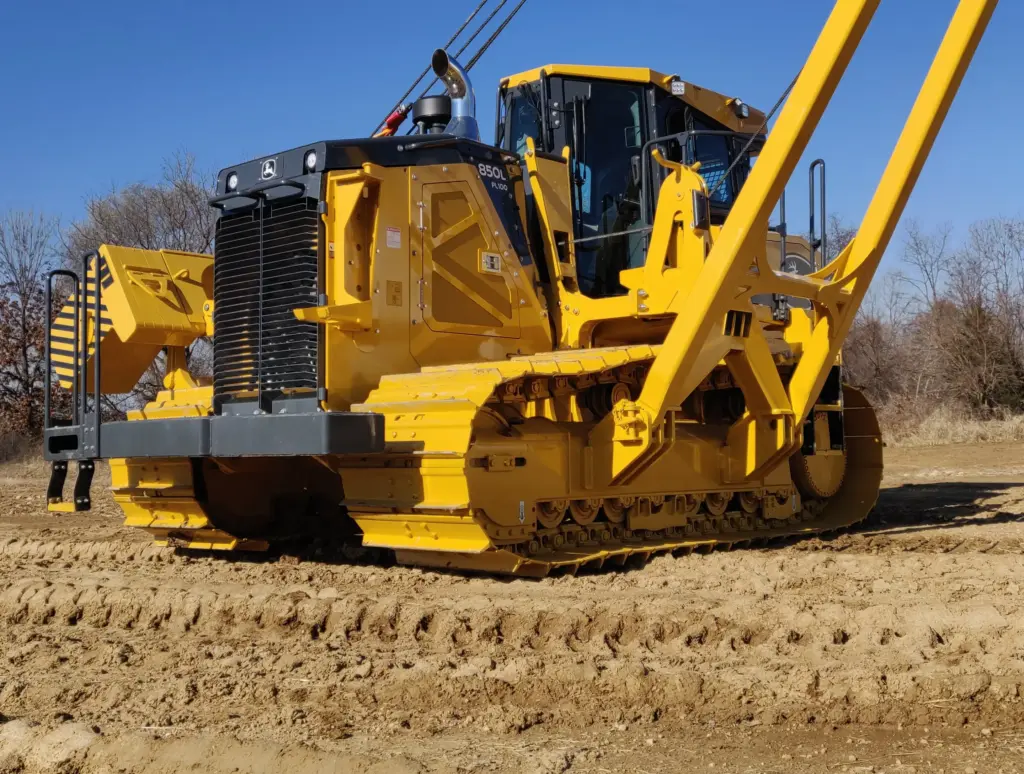
These are exactly the areas purpose-built pipeline machines are engineered around. Midwestern Manufacturing’s sideboom and pipelayer attachments are built on tracked platforms whose undercarriages distribute weight evenly for traction and stability on soft or uneven ground, with wide-gauge, wide-shoe configurations available on platforms designed for maximum stability and low ground pressure. The side-mounted boom lets crews place pipe alongside the trench without driving over it, reducing ground disturbance in the first place.
Midwestern Sideboom and Pipelayer Attachments
For more than 70 years, Midwestern Manufacturing has built sideboom and pipelayer attachments for CAT, John Deere, and other platforms, engineered for the real conditions of a pipeline right-of-way. Lifting capacities range from 10,000 to over 200,000 lb, on tracked undercarriages built for stability and controlled placement across the varied terrain a spread crosses. The result is equipment that keeps a crew productive on ground where general-purpose lifting machines struggle.
To match a machine to your terrain and lift requirements, contact the Midwestern team.
Frequently Asked Questions
What is ground pressure?
Ground pressure is the downward force a machine exerts on the ground, divided by the contact area of its tracks or tires, usually measured in pounds per square inch (psi). Lower ground pressure means the machine’s weight is spread over a larger area, allowing it to work on softer ground without sinking.
How do you reduce a machine’s ground pressure?
Ground pressure is reduced by increasing contact area relative to weight. Wider track shoes, longer track-on-ground length, and a wider gauge all spread the machine’s weight over more square inches, lowering the pressure exerted on the surface.
Why does ground pressure matter for pipeline work?
Pipeline routes cross wetlands, soft soil, and saturated river approaches where high-ground-pressure machines bog down or damage the right-of-way. Low ground pressure keeps machines mobile on soft ground and reduces surface damage, which also lowers post-construction restoration work.
How does slope affect a sideboom’s lifting capacity?
Working across a side slope shifts a machine’s center of gravity toward the downhill side and reduces the safe working capacity of its side-mounted boom. A load safe on flat ground can approach the limit of stability on a slope, so operators reduce load and reposition as needed.
What makes a machine stable on soft or uneven terrain?
Stability on difficult ground comes from a low center of gravity, a wide track gauge, wide track shoes for contact area, and balanced weight distribution across the undercarriage. Together these keep the machine level, mobile, and predictable under load.
Build Your Spread Around the Ground You Work
Ground pressure and stability decide how much of a right-of-way a crew can actually work, and how safely. Matching the machine to the terrain is one of the most important calls a spread makes. Midwestern Manufacturing’s sideboom and pipelayer attachments are engineered for exactly that range of conditions. Explore our pipelayer attachments or get in touch to match equipment to your project.
Author: Doug G.
Comments are closed.