
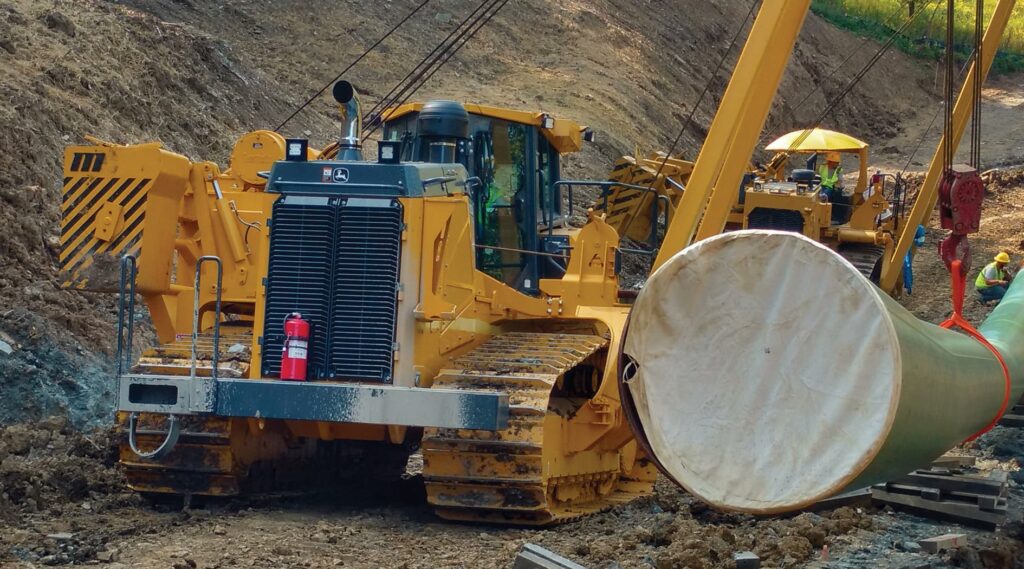
Sideboom Evolution: The History of Pipeline Construction Equipment and How It Shaped Pipelayers
Before the sideboom existed, pipeline contractors improvised. Crews rigged makeshift lifting arms to standard crawler tractors, welded on counterweights, and hoped for the best. The history of pipeline construction equipment is really a story of necessity driving invention—and the sideboom is its most important chapter.
At Midwestern Manufacturing, we’ve built sideboom attachments and pipeline equipment for over 70 years for some of the most demanding spreads in the country. Understanding where sidebooms came from helps explain why modern pipelayer design looks the way it does—and what today’s buyers should expect when evaluating equipment.
The Early Days: Before the Engineered Sideboom
Pipeline construction in the early 20th century was brutally manual. Pipe was laid by hand, with crews using wooden skids, block-and-tackle systems, and sheer manpower to lower sections into the trench. As demand for oil and gas infrastructure grew—particularly through the 1920s and 1930s—the industry needed something faster and more capable.
The crawler tractor was the first answer. Machines like the Caterpillar D8 were already moving earth on pipeline right-of-ways. It didn’t take long for field crews to recognize that with the right modification, those same machines could lift pipe too.
But here’s where the history gets important: what separated effective early pipelayers from dangerous ones wasn’t the base machine—it was the quality of the sideboom system attached to it. Improvised field modifications varied wildly in their load capacity, counterweight balance, and structural integrity. Engineered sideboom attachments, by contrast, brought repeatable performance, defined load ratings, and real design integrity to those same dozer platforms.
That distinction is central to Midwestern Manufacturing’s story. We built our business on designing and manufacturing fully engineered sideboom attachments—systems built to ASME standards, not improvised in the field. That approach remains the foundation of what we do today.
The Post-War Pipeline Boom: Engineering Raises the Standard
World War II accelerated infrastructure demand across North America. The postwar era brought massive pipeline construction projects—natural gas networks, crude oil transmission lines, and cross-country systems requiring thousands of miles of pipe to be laid efficiently and safely.
This surge in demand didn’t just call for more equipment—it called for better equipment. The pipeline industry began to recognize that improvised sideboom modifications, however creative, had real limits in terms of safety and performance. Engineered solutions were no longer optional; they were a competitive and operational necessity.
Key design priorities crystallized during this era:
- Lateral stability under load—critical for safe pipe lowering operations
- Controlled, consistent boom travel for precise placement
- Counterweight systems engineered for actual lifting capacity, not estimated
- Track width and ground pressure suited to right-of-way conditions
- Defined load ratings that could be communicated, verified, and trusted
Midwestern Manufacturing was part of this shift from the beginning. While the broader industry wrestled with how to standardize pipeline lifting equipment, we focused on what we do best: engineering sideboom attachments for the crawler platforms contractors were already running. That specialization—deep engineering focus on the attachment, designed to work with the world’s best base machines—is what has defined Midwestern for more than 70 years. Explore our full line of pipelayer attachments to see how that legacy translates into today’s equipment.
How Sideboom Design Evolved Decade by Decade
The sideboom attachments of the 1950s were a major leap forward—but they were still relatively blunt instruments. Over the following decades, sideboom engineering became increasingly precise, driven by larger pipe diameters, more demanding terrain, and tightening safety standards.
1960s–1970s: Bigger Pipe, Bigger Demands
As pipeline diameters grew—pushed by increasing energy demand—sideboom attachments had to scale with them. Booms grew longer, counterweight systems became more sophisticated, and load ratings climbed. Manufacturers began differentiating their products by lifting class, and the importance of matching the right sideboom to the right base machine became a real engineering discipline.
1980s–1990s: Safety Standards and Hydraulic Precision
Regulatory pressure—driven in large part by OSHA standards for cranes and lifting equipment—forced sideboom manufacturers to formalize load ratings, improve operator visibility, and engineer more reliable control systems. Hydraulics replaced many mechanical systems, giving operators more precise control over boom movement and winch speed.
This era also saw a maturation in how sideboom attachments were integrated with their host machines. Frame geometry, mounting systems, and hydraulic interfaces became more standardized—making the attachment-to-platform relationship more engineered and less improvised. At Midwestern, this period reinforced our conviction that sideboom design is a serious engineering discipline, not an accessory market.
2000s–Present: Precision, Attachments, and Fleet Efficiency
Modern sideboom engineering reflects the realities of today’s pipeline spreads: tighter project timelines, leaner crews, more complex terrain, and greater expectations for precision and uptime. Contemporary pipelayer attachment systems feature:
- Engineered counterweight systems calculated for specific lift scenarios and boom configurations
- Integrated winch systems designed as core components—not afterthoughts
- Tracked stability optimized for side-slope and soft-ground performance
- Compatibility with support attachments including hoist systems, recovery winches, and pipe hooks
- Load monitoring and anti-two-block systems that protect operators and equipment
For today’s heavy pipeline spreads, winch capacity has also become a defining spec. Our post on heavy duty winch systems for extreme loads covers how modern winch engineering has evolved alongside the demands of large-diameter pipeline work. The Pipeline & Gas Journal has also documented these advances across decades of industry coverage, tracking how pipeline construction equipment has evolved alongside the infrastructure it builds.
Why Engineered Attachments Still Matter
It’s worth pausing on what the shift from field-improvised sideboom mods to engineered attachments actually means in practice—because it’s still relevant today. Improvised setups are sometimes still seen in the field, particularly in cost-constrained situations. They appear flexible and cheap. But they carry real risk.
The core problem is that improvised sideboom configurations don’t have defined load ratings—they have estimates. Counterweight balance is guesswork. Boom geometry isn’t optimized for lateral stability. And when something fails under load, it fails badly.
Engineered sideboom attachments solve this at the design level. Every component is calculated to work with the others—the winch, boom, counterweight geometry, and mounting system function as an integrated engineering system, not a collection of parts bolted to a frame. That integration is the foundation of safe, predictable pipe-lifting performance. It’s also what makes compliance with ASME codes and standards achievable and load ratings meaningful.
This is the standard the industry learned—sometimes the hard way—and it’s the standard Midwestern has held itself to since the beginning.
What Modern Buyers Should Expect from Today’s Sideboom Systems
Understanding this history isn’t just academic—it directly informs what a modern buyer should look for when evaluating sideboom attachments and pipelayer configurations.
A well-engineered sideboom attachment should offer:
- Rated lifting capacity matched to your pipe diameter and project requirements
- A fully engineered winch system—integrated, not added on
- Counterweight geometry designed for the machine’s specific boom length and load range
- Compatibility with the CAT or John Deere crawler platform you’re already running
- Manufacturer support and parts availability for long-term serviceability
- Compliance with current ASME and OSHA standards
If you’re still evaluating whether a sideboom is the right tool for your project, our breakdown of sideboom vs. crane vs. excavator performance on real jobsites is a good place to start. Modern spreads also depend on a full suite of support equipment. Midwestern’s recovery winch attachments and load monitoring and anti-two-block systems are engineered to the same standard as our sideboom attachments—purpose-built for pipeline operations, not adapted from general-purpose equipment.
What you should be skeptical of: any sideboom setup that feels improvised—where load ratings are unclear, counterweight geometry is approximate, or the attachment doesn’t have documented engineering behind it. The history of sideboom evolution is the story of the industry learning that engineered design isn’t a luxury. It’s a safety and productivity requirement.
Where Midwestern Manufacturing Fits in the Sideboom Story
At Midwestern Manufacturing, we’ve spent over 70 years doing one thing exceptionally well: engineering sideboom attachments and pipeline equipment that perform where it matters most—on the jobsite.
Our pipelayer attachments are built for CAT and John Deere crawler platforms across a wide range of lifting classes, from 10,000-lb light-duty configurations to 220,000-lb heavy-lift systems. We also manufacture recovery winch attachments—and if you’re trying to select the right pull rating for your job, our guide on choosing between 30,000, 55,000, and 100,000 lb winch configurations walks through the decision in detail. We also offer hoist attachments, line sagging winches, wetdecks, hydrostatic test units, and a comprehensive inventory of pipeline supplies—because we understand that the sideboom is the centerpiece of a pipeline spread, not the whole story.
The evolution of sideboom design has always been driven by field performance. Attachments that couldn’t handle the terrain, the load, or the conditions didn’t survive in the market. The ones that did were engineered by people who understood what pipeline contractors actually needed.
That’s the standard we hold ourselves to—and it’s the standard the history of pipeline construction equipment demands.
Whether you’re spec’ing your next pipelayer attachment or optimizing your fleet, contact Midwestern Manufacturing today to talk with our team.
Frequently Asked Questions
When were sidebooms first used in pipeline construction?
Early sideboom modifications—field-fitted crawler tractors with side-mounted lifting arms—began appearing on pipeline spreads in the 1920s and 1930s. Fully engineered sideboom attachment systems emerged in the postwar era as energy infrastructure demand surged and the limitations of improvised setups became undeniable.
What is the difference between an improvised sideboom mod and an engineered sideboom attachment?
An improvised modification uses components not designed for the application—load ratings are estimates, counterweight balance is approximate, and boom geometry isn’t optimized for lateral stability. An engineered sideboom attachment integrates the winch, boom, counterweight, and mounting system into a single calculated design, built to ASME standards with defined load ratings and documented performance characteristics.
How has sideboom design changed in recent decades?
Modern sideboom attachments feature hydraulic control systems, engineered counterweight geometry, integrated winches, and track-platform compatibility designed for challenging terrain. OSHA and ASME standards have also formalized load ratings and operator requirements. Support attachments—including recovery winches, hoist systems, and load monitoring—have become increasingly standard on modern pipeline spreads.
What sideboom attachments does Midwestern Manufacturing build?
Midwestern Manufacturing designs and manufactures engineered sideboom attachments for CAT and John Deere crawler platforms across lifting classes from 10,000 lb to 220,000 lb. We also build recovery winch attachments, hoist attachments, line sagging winches, wetdecks, and hydrostatic test units—along with one of the most comprehensive pipeline supply inventories in the industry.
What should I look for when evaluating a sideboom attachment?
Prioritize rated lifting capacity matched to your pipe diameter, an integrated and engineered winch system, counterweight geometry designed for the specific boom length and load range, and compatibility with your existing CAT or John Deere platform. Also confirm ASME compliance and long-term manufacturer support for parts and service.
Author: Doug G.
Comments are closed.