
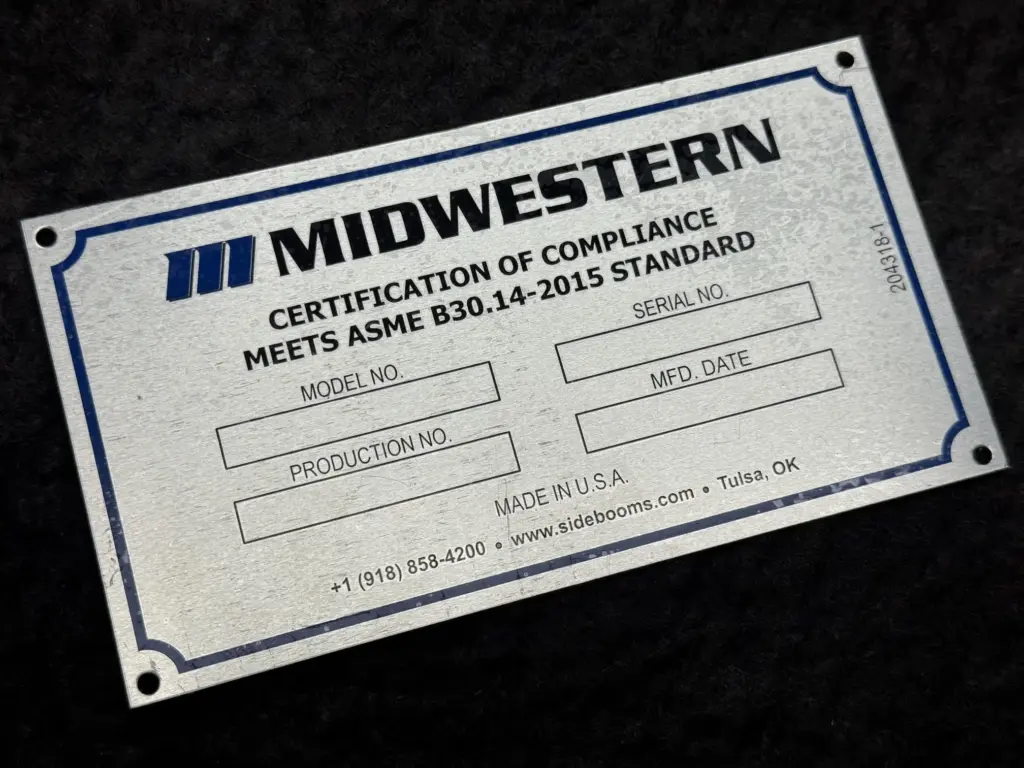
ASME B30.14 Sideboom Standard: What Contractors and Operators Actually Need to Know
Most pipeline contractors know the ASME B30.14 sideboom standard exists. Fewer know exactly what it requires—or that it isn’t just an industry best practice. It’s a legally binding federal standard, incorporated by reference into OSHA regulations. If your sideboom equipment or operations don’t meet it, you’re not just out of spec. You’re out of compliance with federal law.
This isn’t meant to be a scary compliance lecture. It’s a plain-language breakdown of what ASME B30.14 actually covers, what it means in practice for your equipment and crew, and where Midwestern-built sideboom attachments fit into the picture.
What Is ASME B30.14?
The ASME B30.14 sideboom standard is the dedicated volume of the American Society of Mechanical Engineers’ B30 Safety Standard written specifically for side boom tractors—what the industry calls sidebooms or pipelayers. It covers construction, installation, operation, inspection, testing, and maintenance of sideboom equipment used for pipe laying and lifting operations.
The standard applies to any sideboom with a rated load above one ton, powered by an internal combustion engine. That covers essentially every pipelayer on a working pipeline spread.
What makes B30.14 more than just a guideline: it has been incorporated by reference into OSHA’s 29 CFR 1926.1440, the federal regulation specifically governing sideboom cranes in construction. OSHA explicitly lists which sections of B30.14 must be met—load ratings, boom requirements, rope and reeving, travel requirements, and operator qualifications. Compliance isn’t optional.
The Five Areas B30.14 Covers
The standard is organized around five operational areas. Here’s what each means on the ground.
1. Construction and Equipment Requirements
This is where the engineering requirements live. Load ratings must be established and clearly marked on the machine. Booms must meet defined structural requirements. Ropes and reeving accessories must meet rated capacity specs. Welded construction must meet specific standards. Clutch and brake systems must be protected.
These requirements are exactly why it matters whether your sideboom attachment was engineered or improvised. A properly rated, engineered sideboom attachment has defined load ratings built into its design from the start—not estimated after the fact. That’s the difference between meeting this section of B30.14 and hoping you do.
2. Inspection, Testing, and Maintenance
B30.14 requires two levels of inspection: frequent and periodic.
Frequent inspection is visual examination performed by the operator or designated personnel before and during use. No formal documentation is required, but the examination has to happen. Things being checked: control function, rope condition, boom condition, visible structural integrity.
Periodic inspection is a more thorough examination performed at intervals defined by the standard, based on usage severity. This one requires documentation. A designated person—someone with defined knowledge and authority—must perform and record it.
The standard also requires a rated load test for equipment that has been altered or modified. If you’ve had a sideboom attachment reworked or rebuilt, that test is required before returning to service.
3. Load Ratings
Section 14-1.1 on load ratings is one of the specific sections OSHA pulls directly into 1926.1440. Load ratings must be established for each configuration of the machine—they’re not a general estimate. They have to account for boom length, counterweight configuration, and operating radius.
This is why counterweight engineering matters beyond just keeping the machine from tipping. The counterweight geometry directly affects what the rated load actually is. Sideboom attachments where counterweight is an afterthought—or not engineered to the specific boom—can’t produce accurate load ratings. And without accurate load ratings, you can’t demonstrate B30.14 compliance.
4. Operator Qualifications
Section 14-3.1.2 requires sideboom operators to be qualified. OSHA’s 1926.1440 incorporates this requirement directly—with one notable carve-out: 1926.1440 removes the standard general operator certification requirement (1926.1427) that applies to other cranes, meaning sideboom operators aren’t required to hold the same formal certification as mobile crane operators. But they still have to be qualified—meaning they need documented knowledge and demonstrated ability for the specific equipment they’re operating.
For fleet managers and contractors: this matters for your training documentation. Operator qualification for sidebooms needs to be recorded and defensible, even if the pathway looks different than crane certification.
5. Operating Practices
The operating practices section (14-3.1.3 and 14-3.2.3) covers the day-to-day conduct of lifting operations. OSHA’s 1926.1440 pulls in specific paragraphs—covering prohibited operations, load control, signaling, and movement with a suspended load.
A few practical points from this section: sidebooms in which the boom is designed to free-fall (live boom) are only permitted if manufactured prior to November 8, 2010. That’s a hard cutoff. Modern equipment and attachments don’t use free-fall boom systems—but it’s worth knowing if you’re running older iron. On the monitoring side, load monitoring and anti-two-block systems exist specifically to support the operating practice requirements around knowing your load and protecting against two-block events.
What This Means If You’re Buying or Speccing Equipment
If you’re evaluating sideboom configurations—whether new attachments or conversions of existing crawlers—ASME B30.14 sideboom compliance should be part of the conversation from the start, not a checkbox at the end. Our breakdown of sideboom vs. crane vs. excavator on real jobsites gets into some of the operational tradeoffs, but from a compliance standpoint, the sideboom-specific standard is B30.14—and it needs to be built into your equipment spec.
The questions worth asking any sideboom manufacturer or conversion shop:
- Are load ratings established per B30.14 section 14-1.1, for each boom length and configuration?
- Is counterweight geometry engineered to the specific boom and rated load—not estimated?
- Does the attachment meet the boom structural requirements of 14-1.7.1?
- Are ropes and reeving rated to the machine’s lifting capacity per 14-1.5?
- What documentation supports the rated load test if the machine has been modified?
If any of those questions get a vague answer, dig deeper before the equipment goes on a spread.
How Midwestern Attachments Are Built for B30.14 Compliance
At Midwestern Manufacturing, our sideboom attachments are engineered to meet ASME B30.14 requirements from the ground up—not retrofitted to pass inspection. Load ratings are calculated for each configuration. Counterweight geometry is specific to the boom length and rated capacity. Structural components are designed to the standard’s requirements, not adapted from general-purpose equipment.
That engineering approach is also why our attachments work on CAT and John Deere crawler platforms the way they do—the integration between attachment and host machine is calculated, not assumed. And it’s why we can provide the documentation contractors and fleet managers need to demonstrate compliance when it matters.
For a broader look at how sideboom engineering has evolved alongside standards like B30.14, our post on the history of pipeline construction equipment covers how the industry got from improvised field mods to the engineered systems the standard now requires. The Pipeline & Gas Journal has also tracked this progression across decades of industry coverage.
Questions about compliance, equipment specs, or how our attachments are rated? Contact us—we’re happy to walk through the detail.
Frequently Asked Questions
What does ASME B30.14 cover for sidebooms?
The ASME B30.14 sideboom standard covers the construction, installation, operation, inspection, testing, and maintenance of side boom tractors used for pipe laying and lifting operations. It establishes requirements for load ratings, boom and rope construction, operator qualifications, inspection intervals, and operating practices. It applies to any sideboom with a rated load above one ton. Because it’s incorporated into federal law via OSHA 29 CFR 1926.1440, compliance is mandatory on construction jobsites—not optional.
Is ASME B30.14 legally required?
Yes. ASME B30.14-2004 is incorporated by reference into OSHA 29 CFR 1926.1440, the federal regulation governing sideboom cranes in construction. OSHA specifies which sections are mandatory—including load ratings, boom requirements, rope and reeving, and operator qualifications. Non-compliance is a federal violation, not just an industry standard miss.
Do sideboom operators need to be certified under B30.14?
Sideboom operators must be qualified under the ASME B30.14 sideboom standard, section 14-3.1.2, which OSHA incorporates into 1926.1440. However, 1926.1440 specifically exempts sideboom operators from the formal crane operator certification requirement (1926.1427) that applies to other cranes. Operators still need to be qualified and that qualification needs to be documented—it just follows a different pathway than mobile crane certification.
What’s the difference between frequent and periodic inspections under B30.14?
Frequent inspections are visual examinations performed by the operator or designated person before and during use—no formal documentation required, but they must happen. Periodic inspections are more comprehensive, performed at intervals based on usage severity, and must be documented by a designated person with appropriate training and authority.
Does Midwestern Manufacturing build sideboom attachments to ASME B30.14 standards?
Yes. Midwestern sideboom attachments are engineered to meet ASME B30.14 requirements, including defined load ratings per configuration, engineered counterweight geometry, and compliant boom and rope specifications. Our attachments are built for CAT and John Deere crawler platforms with documented engineering behind every rated configuration. Contact us for spec details on any specific model.
Author: Doug G.
Comments are closed.