
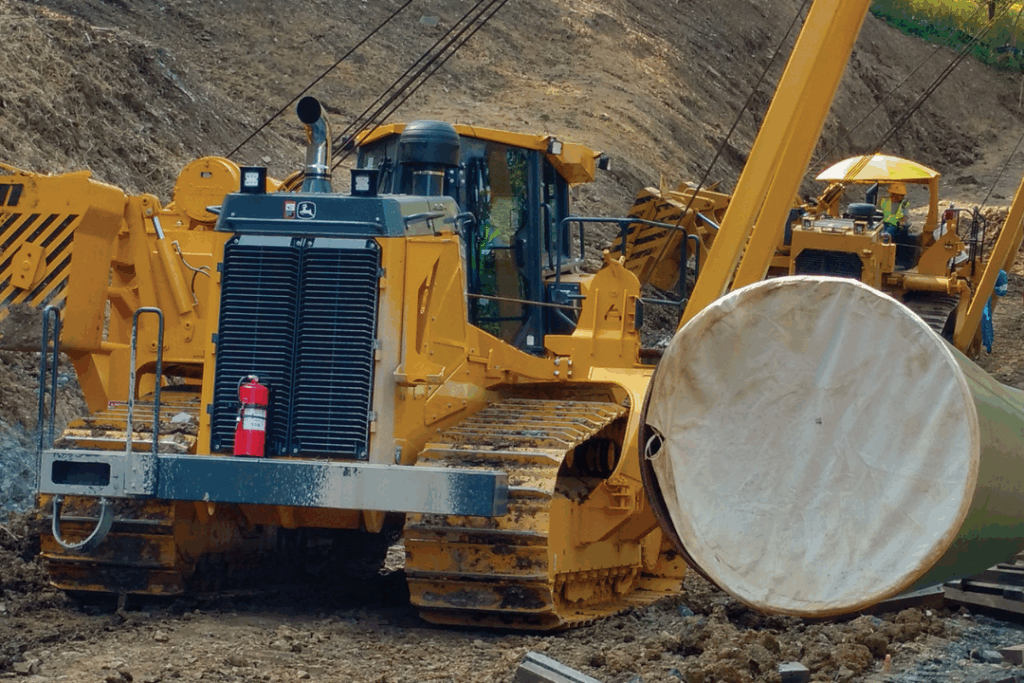
Why Pipelayers Are Essential for Efficient Pipeline Construction
Building the Backbone of Modern Energy Infrastructure
At Midwestern Manufacturing, we’ve spent decades supporting crews who build and maintain the pipelines that power modern industry. From energy distribution to water transport, pipeline construction requires accuracy, strength, and coordination at every stage. Among the most critical pieces of equipment on any pipeline jobsite are Pipelayers, which play a central role in handling, positioning, and installing pipe safely and efficiently. These machines do far more than lift pipe off the ground—they directly influence productivity, safety, and the long-term integrity of the pipeline system.
The Role of Pipelayers in Pipeline Construction
Pipeline installation is a complex, step-by-step process that depends on precise coordination. Pipe sections must be lifted from staging areas, aligned with the trench, positioned for welding, and carefully lowered into place. Pipelayers are purpose-built for these tasks, combining tracked mobility with powerful lifting capability and controlled movement. Unlike general construction equipment, they are designed specifically to handle long, heavy pipe sections while maintaining stability and balance. This specialization allows crews to work efficiently across uneven terrain and changing ground conditions.
Improving Jobsite Efficiency Through Controlled Handling
Efficiency on a pipeline project depends on smooth, uninterrupted workflow. When pipe handling is slow or inconsistent, every downstream task is delayed. Pipelayers help maintain momentum by allowing crews to move pipe quickly and accurately without repeated adjustments. With proper lifting points and controlled lowering, pipe sections can be positioned correctly the first time, reducing the need for repositioning or rework. This controlled handling keeps welding, inspection, and coating operations moving forward on schedule, helping crews meet tight project timelines.
Enhancing Safety for Crews and Equipment
Pipeline construction involves heavy materials, confined work zones, and constant coordination between operators and ground crews. Safety risks increase significantly when pipe handling is unpredictable or improvised. Pipelayers reduce these risks by providing stable, controlled lifting that minimizes swinging, rolling, or sudden movement. Operators can place pipe precisely while maintaining clear sightlines and communication with rigging crews. This predictability supports safer work practices and aligns with guidance from organizations such as the Occupational Safety and Health Administration, which emphasizes proper material handling and equipment use on construction sites.
Supporting Accurate Alignment and Installation
Proper pipe alignment is essential for high-quality welds and long-term pipeline performance. Misalignment can lead to weld defects, coating damage, or stress points that compromise system integrity over time. Pipelayers allow operators to fine-tune pipe positioning during fit-up, ensuring that each section aligns correctly before welding begins. This accuracy improves weld quality and reduces the likelihood of costly repairs later in the project. Precision during installation directly contributes to the durability and reliability of the finished pipeline.
Adapting to Challenging Terrain and Conditions
Pipeline routes rarely follow perfectly flat or predictable ground. Crews often work across hills, slopes, wetlands, rocky terrain, and remote environments where access is limited. Pipelayers are designed to perform in these conditions, using tracked undercarriages that provide stability and traction on uneven surfaces. Their ability to move alongside the trench while carrying heavy loads allows crews to maintain progress even in difficult environments. This adaptability reduces downtime caused by terrain challenges and helps projects stay on track regardless of location.
Reducing Equipment Wear and Project Costs
Using the right equipment for pipe handling doesn’t just improve efficiency—it also protects the pipe itself. Improper lifting methods can damage coatings, dent pipe walls, or introduce defects that require repair or replacement. Pipelayers are engineered to distribute load evenly and support pipe securely, reducing the risk of damage during handling. By protecting materials and minimizing rework, crews lower overall project costs and avoid delays caused by preventable equipment or material issues.
Improving Coordination Across Pipeline Crews
Pipeline construction relies on coordination between multiple teams, including operators, welders, inspectors, coating crews, and supervisors. When pipe handling is consistent and predictable, coordination improves across the entire jobsite. Pipelayers provide reliable movement that crews can anticipate, making it easier to schedule tasks and manage workflow. Inspectors encounter fewer alignment issues, welders experience smoother fit-ups, and supervisors gain better visibility into daily progress. Strong coordination leads to faster completion and higher-quality outcomes.
Supporting Compliance and Quality Standards
Pipeline projects must meet strict regulatory and engineering standards related to safety, strength, and environmental protection. Accurate handling and placement of pipe are foundational to meeting these requirements. Pipelayers support compliance by enabling controlled installation practices that reduce stress on pipe sections and maintain proper alignment. These practices align with engineering standards published by organizations such as the American Society of Mechanical Engineers, which emphasize proper installation techniques to ensure pipeline integrity.
Increasing Productivity on Large-Scale Projects
As pipeline projects grow in size and complexity, productivity becomes increasingly important. Large-diameter pipe, long construction spreads, and tight deadlines demand equipment that can keep up with production goals. Pipelayers allow crews to handle larger sections efficiently, reducing bottlenecks and keeping operations moving forward. Their ability to lift, transport, and position pipe repeatedly throughout the day makes them indispensable on high-volume projects where time and accuracy are critical.
Strengthening Long-Term Pipeline Performance
The quality of installation has a direct impact on a pipeline’s long-term performance. Poor handling during construction can introduce issues that surface years later as leaks, corrosion, or structural failure. By supporting proper placement and minimizing damage during installation, pipelayers contribute to the long-term reliability of the pipeline system. Careful handling protects coatings, maintains alignment, and reduces stress points, all of which help extend the service life of the asset.
Choosing Equipment That Matches the Job
Not all pipeline projects have the same requirements, which is why selecting the right equipment is so important. At Midwestern Manufacturing, we understand the demands crews face in the field and design equipment to meet those challenges head-on. Pipelayers must deliver strength, stability, and control in real-world conditions, not just on paper. Matching the right machine to the job ensures crews can work efficiently while maintaining the highest standards of safety and quality.
Building Stronger Projects from the Ground Up
Pipeline construction depends on reliable equipment, skilled crews, and proven processes working together seamlessly. Pipelayers play a foundational role in that equation by enabling safe, accurate, and efficient pipe handling throughout every phase of installation. At Midwestern Manufacturing, we build solutions that support the people doing the work and the infrastructure they create. When you’re ready to improve productivity, enhance safety, and deliver higher-quality pipeline projects, invest in equipment engineered for real-world performance and put your operation on the path to long-term success today.
Author: Joe B.
Comments are closed.