
Hydrostatic vs. Pneumatic Testing: Why Water Wins on Pipeline
When it comes to hydrostatic testing vs. pneumatic testing, most pipeline contractors already know which method they’ll be using before the conversation starts. Hydrostatic testing — pressurizing a pipeline with water — is the industry standard for a reason. But understanding why that’s the case, and where the narrow exceptions exist, is worth knowing clearly. It’s the kind of thing that comes up in conversations with engineers, inspectors, and project owners — and having a grounded answer matters.
At Midwestern Manufacturing, we’ve built hydrostatic fill and test equipment for pipeline contractors for over 70 years. This is our honest take on both methods.
The Physics Behind the Difference
The distinction between hydrostatic and pneumatic testing comes down to one fundamental property: compressibility.
Water is essentially incompressible under the pressures used in pipeline testing. When you pressurize a water-filled pipeline and something fails, the water finds the path of least resistance — it leaks. The energy release is controlled and localized. The failure is bad, but it’s manageable.
Gas is compressible. When you pressurize a pipeline with air or nitrogen to the same pressure, the gas stores a significant amount of elastic energy — energy that doesn’t exist in the hydrostatic version of the same test. When a gas-pressurized system fails, that stored energy releases instantaneously. The result isn’t a leak. It’s closer to an explosion.
The numbers make this concrete: compressed gas stores roughly 200 times more energy per unit volume than water at equivalent pressure. A failure of 200 feet of 36-inch pipe at 500 psi during a pneumatic test can generate a blast wave equivalent to approximately 80 pounds of TNT. That figure comes from engineering analysis of pneumatic test failures and it’s the reason the industry treats pneumatic testing of large-diameter pipeline as something to be avoided wherever possible — not just a different option.
What the Regulations Actually Say
For oil and gas transmission pipelines in the United States, hydrostatic testing is not just preferred — it is the required method under PHMSA regulations and ASME B31.8 for new construction and post-modification testing. Pneumatic testing of high-pressure transmission pipeline is not a permissible alternative under these standards — it simply isn’t on the table for that application.
In process piping governed by ASME B31.3, pneumatic testing is permitted as an alternative to hydrostatic testing, but only under specific conditions: the system must be documented as unsuitable for water, a thorough hazard analysis must be performed and approved, the test pressure is reduced (110% of design pressure rather than 150%), and mandatory safety exclusion zones must be established. The code treats pneumatic testing as a last resort requiring explicit justification — not an equivalent alternative.
OSHA’s pressure testing safety requirements similarly emphasize the higher hazard profile of pneumatic testing and require additional controls when it is used. The regulatory posture across the relevant standards is consistent: hydrostatic is the default, pneumatic requires justification.
Where Pneumatic Testing Has a Legitimate Place
Pneumatic testing isn’t without legitimate applications. Being honest about that is part of understanding the comparison clearly.
The scenarios where pneumatic testing is genuinely appropriate tend to share a common thread: water itself is the problem.
- Systems that cannot tolerate moisture — instrument air lines, some specialty process piping, or systems where even trace water causes corrosion or contamination issues
- Weight-sensitive applications where flooding a system with water would structurally overload the supporting structure
- Small-bore tubing and control lines where the test volume is minimal and the energy stored at test pressure remains manageable
- Remote locations where suitable water supply is genuinely unavailable and the pipe diameter and test pressure keep stored energy within acceptable limits
What these situations have in common: they’re typically small-diameter, lower-pressure, or have a documented technical reason that makes water incompatible. They are not large-diameter transmission pipeline. The moment you’re talking about significant pipe diameter and meaningful test pressure, the stored energy calculation shifts the risk profile in a direction that regulations and engineering judgment both point away from.
The Practical Argument for Hydrostatic on Pipeline Work
Beyond safety and regulatory compliance, hydrostatic testing has operational advantages that matter on a real pipeline spread.
Water’s incompressibility makes leak detection more precise. A small pressure drop in a hydrostatic test is a meaningful signal — the system absorbed a measurable volume of water somewhere. In a pneumatic test, small leaks can be masked by the compressibility of the gas, making it genuinely harder to detect marginal integrity issues that hydrostatic testing would catch cleanly. This is part of why PHMSA treats the hydrotest as the strength and leak verification standard for transmission pipeline.
Water is also available, non-reactive with steel pipe under normal testing conditions, and — critically — when the test is done, the failure mode of a problem found during testing is a water leak onto the ground. Manageable. Documented. Reported. Not a pressure wave.
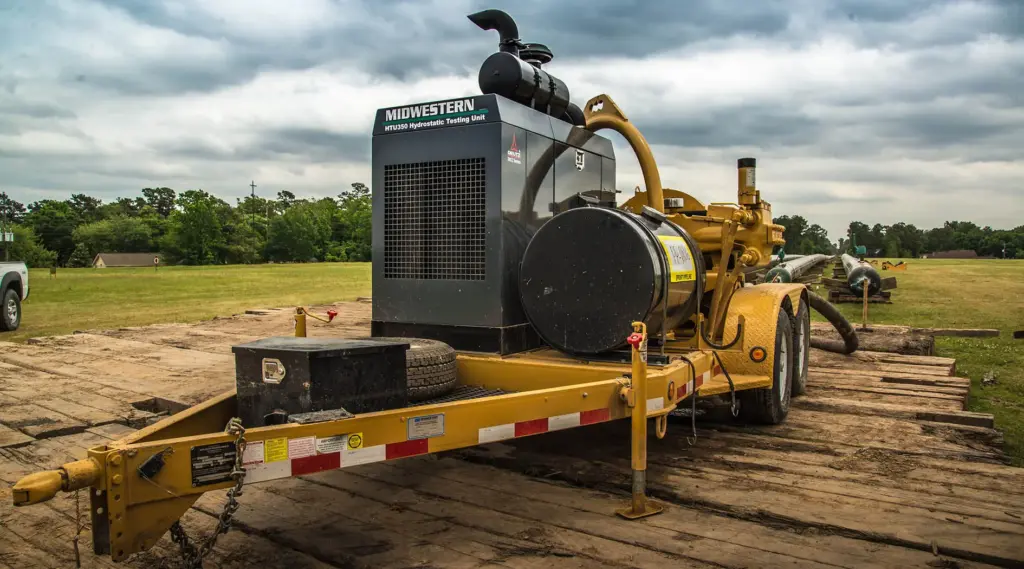
The equipment side of hydrostatic testing has also evolved significantly. Midwestern’s hydrostatic fill and test units are engineered as two-in-one systems — a high-flow centrifugal fill pump and a high-pressure triplex test pump running from a single diesel power source. The HTU-350, HTU-500, and HTU-850 are built specifically for pipeline testing operations — not adapted from general industrial equipment. The precision and control they provide during pressurization are part of what makes a well-run hydrostatic test a reliable, defensible result.
The Bottom Line
Hydrostatic testing vs. pneumatic testing isn’t really a close call for pipeline work. The physics, the regulations, and decades of industry experience all point the same direction. Water-based testing is safer, more sensitive to leaks, mandated by the applicable codes for transmission pipeline, and the method the industry has standardized around for good reason.
Pneumatic testing has a legitimate role in specific, documented cases where water is genuinely incompatible with the system being tested. Outside those narrow circumstances, particularly on oil and gas transmission pipeline, it’s not an alternative — it’s a risk that the regulatory framework exists specifically to prevent.
Midwestern has been building pipeline testing equipment since the industry was working through these questions. If you’re evaluating hydrostatic test unit options for an upcoming project, contact our team — we’re happy to talk through the right configuration for your line spec and test requirements. And if you’re newer to hydrostatic testing equipment generally, our post on what hydrostatic testing units are and how they work is a good place to start.
Frequently Asked Questions
What is the difference between hydrostatic testing and pneumatic testing?
Hydrostatic testing pressurizes a pipeline or vessel with an incompressible liquid — almost always water — to verify strength and leak integrity. Pneumatic testing uses a compressible gas, typically air or nitrogen. The fundamental difference is energy storage: compressed gas stores roughly 200 times more energy per unit volume than water at equivalent pressure, meaning a failure during pneumatic testing releases that energy explosively rather than as a controlled leak. This is why hydrostatic testing is the mandated standard for oil and gas pipeline work.
Is pneumatic testing allowed on oil and gas pipelines?
For high-pressure transmission pipelines regulated under PHMSA and ASME B31.8, pneumatic testing is not a permissible alternative to hydrostatic testing for new construction or post-modification strength verification. In process piping governed by ASME B31.3, pneumatic testing is permitted as a documented alternative under specific conditions, but the code treats it as a last resort requiring hazard analysis and approval — not an equivalent option.
Why is hydrostatic testing safer than pneumatic testing?
Water is incompressible, so it stores negligible energy compared to compressed gas at the same pressure. If a water-pressurized system fails, water leaks — the energy release is localized and manageable. If a gas-pressurized system fails, the stored elastic energy releases instantaneously. Engineering analysis of pneumatic test failures has found that a failure of 200 feet of 36-inch pipe at 500 psi can produce a blast equivalent to approximately 80 pounds of TNT.
When is pneumatic testing appropriate?
Pneumatic testing is appropriate when water is genuinely incompatible with the system being tested — moisture-sensitive lines, weight-sensitive structures that can’t support a water fill, or small-bore instrumentation and control lines where the stored energy at test pressure remains within manageable limits. In all cases, applicable codes require documented justification, a hazard analysis, reduced test pressure relative to hydrostatic requirements, and mandatory safety exclusion zones.
What hydrostatic test equipment does Midwestern Manufacturing make?
Midwestern manufactures the HTU-350, HTU-500, and HTU-850 — two-in-one hydrostatic fill and test units engineered for pipeline testing operations. Each combines a high-flow centrifugal fill pump and a high-pressure triplex test pump on a single diesel-powered trailer, with precise pressure control and instrumentation built for accurate, compliant pipeline testing. Contact us to discuss which unit fits your project requirements.
Author: Joe B.
Comments are closed.