
30,000 vs. 55,000 vs. 100,000 lb Winch: Choosing the Right Recovery Winch Line Pull
Adding a winch attachment to your excavator or loader significantly expands what that machine can do on the jobsite. Equipment recovery, pipe pulling, heavy load repositioning, and controlled lowering operations all become possible with the right attachment in place.
But recovery winch line pull is the spec that determines whether the winch you select can actually handle the job. Choose too little capacity and you’re undersized for your load. Choose more than you need and you’re carrying weight and cost that the application doesn’t justify. Not to mention, matching it up to the weight capacity of the base machine.
At Midwestern Manufacturing, we manufacture three recovery winch attachments — the M30W at 30,000 lb, the M55W at 55,000 lb, and the M100W at 100,000 lb line pull. Each is built for a specific machine type and load range. Here’s how to understand the differences and select the right one for your application.
What Is Recovery Winch Line Pull and Why Does It Matter?
Line pull is the rated pulling force a winch can exert at the first layer of wire rope on the drum. It’s the primary performance specification for any winch attachment and the number that determines whether the winch can move the load you’re working with.
However, line pull isn’t the only factor in the selection decision. The machine the winch mounts to, how it integrates with that machine’s hydraulic system, the wire rope diameter and length supplied, and the gear ratio all affect real-world performance. Two winches with the same rated line pull can perform very differently depending on how they’re built and how they mount.
With Midwestern’s recovery winch lineup, the differences between the three models go beyond line pull. Properly integrating them onto a machine to handle the loads is key. That distinction shapes everything else about how each winch works in the field.
The M30W: 30,000 lb Line Pull for Loader and Excavator Applications
The M30W Recovery Winch is Midwestern’s entry-level recovery winch, rated at 30,000 lb line pull and designed specifically for loader and excavator platforms.
How It Mounts
The M30W pins to the rear hitch plate of a loader or frame of an excavator. This attachment maintains clearance height, which matters in applications where the machine needs to maneuver in tight spaces after the winch is attached.
The winch ties into the machine’s auxiliary hydraulic circuit and uses the existing cab controls for all winch functions. Installation and removal use bulkhead connections, keeping the process straightforward in the field.
Specs at a Glance
- Line pull: 30,000 lb
- Mount: Rear hitch plate of loader or excavator frame
- Hydraulic circuit: Auxiliary
- Gear type: Planetary, 41:1 gear ratio
- Wire rope: 3/4″ x 200′ with tail chain and hook
- Drum capacity: 3/4″ x 208′
- Shipping weight: Approx. 2,710 lb
When the M30W Is the Right Choice
The M30W fits applications where a loader or excavator is already the primary machine on the jobsite and the load requirements fall within the 30,000 lb range. Common uses include light equipment recovery, pipe pulling on smaller diameter projects, and load repositioning where the loader’s mobility is an advantage.
The 200-foot wire rope length also gives the M30W reach that suits open-ground recovery situations where the winch anchor point may be some distance from the load.
The M55W: 55,000 lb Line Pull for Wheel Loader and Excavator Applications
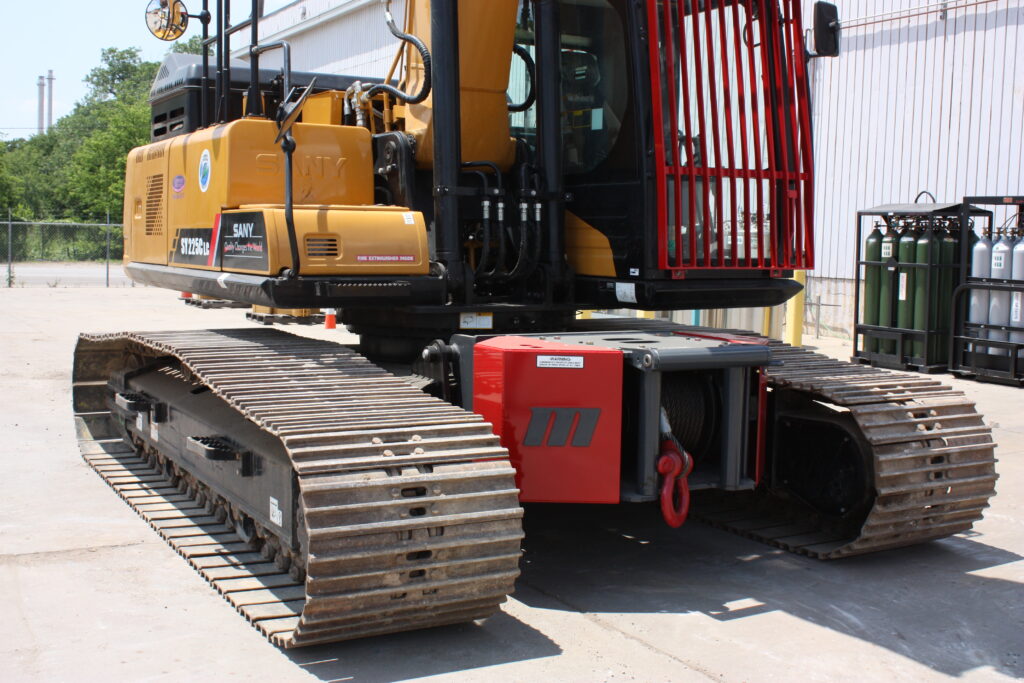
The M55W Recovery Winch steps up to 55,000 lb line pull and can be installed on an excavator lower frame mount or wheel loader rear end.
How It Mounts
The M55W pins to the lower frame of an excavator, mounting below the cab with clearance for full 360° rotation. That rotation capability is a meaningful operational advantage. The excavator can reposition and swing freely without the winch restricting movement, which matters on congested jobsites and during recovery operations where the load direction may change.
The M55W can also mount to the rear of a wheel loader for recovery purposes. Like the M30W, it uses existing cab controls and bulkhead connections for installation and removal.
Specs at a Glance
- Line pull: 55,000 lb
- Mount: Lower frame of excavator or wheel loader rear plate
- Rotation: Full 360° clearance
- Hydraulic circuit: Tram
- Gear type: Planetary, 2-speed motor, 184:1 gear ratio
- Wire rope: 1″ x 150′ with tail chain and hook
- Drum capacity: 1″ x 153′
- Shipping weight: Approx. 4,200 lb
- U.S. Patent No. 11,926,990
When the M55W Is the Right Choice
The M55W is well-suited for mid-range recovery and pulling applications on excavator-based spreads. The 55,000 lb capacity handles a broad range of pipeline and utility jobsite scenarios — equipment recovery, pipe pulling, and heavy load movement — without stepping up to the full capacity and weight of the M100W.
The 2-speed motor also adds operational flexibility. Lower speed provides maximum pulling force for the most demanding loads, while higher speed allows faster line retrieval when working at lighter loads.
The M100W: 100,000 lb Line Pull for Heavy-Duty Excavator Applications
The M100W Recovery Winch is Midwestern’s highest-capacity recovery winch attachment, rated at 100,000 lb line pull for the most demanding excavator applications.
How It Mounts
Like the M55W, the M100W pins to the lower frame of an excavator with full 360° rotation clearance and ties into the tram hydraulic circuit. The mounting system, hydraulic integration, and cab control approach are consistent between the two excavator models — what changes is the wire rope, gear ratio, and rated line pull.
Specs at a Glance
- Line pull: 100,000 lb
- Mount: Lower frame of excavator
- Rotation: Full 360° clearance
- Hydraulic circuit: Tram
- Gear type: Planetary, 2-speed motor, 168:1 gear ratio
- Wire rope: 1-1/4″ x 125′ with tail chain and hook
- Drum capacity: 1-1/4″ x 176′
- Shipping weight: Approx. 4,200 lb
- U.S. Patent No. 11,926,990
When the M100W Is the Right Choice
The M100W is the right choice when the load scenario demands maximum line pull from an excavator platform. Heavy equipment recovery in difficult terrain, large-diameter pipe pulling, and high-resistance load repositioning all benefit from the 100,000 lb capacity.
Notably, the M100W carries the same approximate shipping weight as the M55W at around 4,200 lb, despite doubling the rated line pull. The heavier wire rope — 1-1/4″ versus 1″ — accounts for part of that capacity difference, along with the gear ratio and drum configuration.
Side-by-Side Comparison: M30W vs. M55W vs. M100W
Here’s how the three models compare across the key specs:
- Line pull: M30W — 30,000 lb | M55W — 55,000 lb | M100W — 100,000 lb
- Machine platform: M30W — Loader | M55W — Excavator | M100W — Excavator
- Mount point: M30W — Rear hitch plate | M55W — Lower frame | M100W — Lower frame
- Hydraulic circuit: M30W — Auxiliary | M55W — Tram | M100W — Tram
- Motor type: M30W — Planetary | M55W — Planetary, 2-speed | M100W — Planetary, 2-speed
- Gear ratio: M30W — 41:1 | M55W — 184:1 | M100W — 168:1
- Wire rope: M30W — 3/4″ x 200′ | M55W — 1″ x 150′ | M100W — 1-1/4″ x 125′
- Shipping weight: M30W — ~2,710 lb | M55W — ~4,200 lb | M100W — ~4,200 lb
How to Choose the Right Excavator Winch Line Pull for Your Application
The decision framework is straightforward once you know the key variables:
Start with your machine
If your primary machine is a loader, the M30W or M55W is the right starting point. It’s designed for that platform and integrates cleanly with a loader’s auxiliary hydraulic system. The M100W are excavator-specific — they mount to the lower frame.
Match line pull to your load
A general rule in winch selection is to choose a rated line pull that exceeds your expected maximum load by a meaningful margin. Rated line pull reflects performance at the first layer of rope on the drum. As rope layers build up, effective pull decreases. For loads consistently in the 20,000–25,000 lb range, the M30W fits. Loads in the 40,000–50,000 lb range on an excavator, the M55W is the appropriate choice. And loads approaching or exceeding 75,000 lb, the M100W provides the capacity margin the application requires.
Consider rope length vs. reach requirements
The M30W’s 200-foot wire rope gives it the longest reach of the three models. The M55W supplies 150 feet and the M100W 125 feet. If your application requires pulling from a significant distance — as is common in open-field equipment recovery — rope length factors into the selection alongside line pull.
Contact Midwestern Manufacturing
Midwestern Manufacturing has built recovery winch attachments for pipeline, utility, and heavy equipment applications for more than 70 years. Our full recovery winch lineup includes the M30W, M55W, M100W, and the counterweight-mounted M100W for additional configuration flexibility.
If you’re not sure which winch is right for your machine and application, our team can help you work through the selection. Contact us today.
Frequently Asked Questions
What is recovery winch line pull?
Line pull is the rated pulling force a winch can exert at the first layer of wire rope on the drum. It is the primary specification for comparing winch capacity and the key number for determining whether a winch can handle a given load.
Can the M100W be mounted on a loader?
No. The M100W is designed to pin to the lower frame of an excavator and tie into the auxiliary circuit. They are not compatible with loader rear hitch mounting. The M30W & M55W are the correct model for loader applications.
What is the difference between the M55W and M100W?
The M100W provides double the rated line pull — 100,000 lb vs. 55,000 lb — through a heavier wire rope (1-1/4″ vs. 1″), a higher drum capacity, and a different gear ratio. Both carry the same approximate shipping weight of 4,200 lb.
Do the M55W and M100W require any modification to the excavator?
Both models use bulkhead connections for installation and removal and tie into the existing auxiliary circuit using existing cab controls. Some custom modification to the excavator is required for standard installation.
Author: Joe B.
Comments are closed.